






Author – Yogesh Umbarkar, Vice President at Valtech APAC
As vehicles transition from distributed electronics to centralised computing platforms, software is becoming the defining element of automotive innovation, unlocking continuous upgrades, personalised features and entirely new business models.
The Next Revolution in Automotive Engineering
The automotive industry is undergoing a fundamental shift, from hardware-centric engineering to software-driven innovation. At the center of this transformation is the concept of the Software-Defined Vehicle (SDV), a new vehicle architecture where software controls, upgrades, and personalizes vehicle functionality throughout its lifecycle.
For decades, vehicles were primarily mechanical systems enhanced with electronics. Today, however, software is becoming the core element defining vehicle performance, features, and user experience.
From Distributed Systems to Centralized Intelligence
Traditional vehicles rely on a distributed electronic architecture consisting of multiple electronic control units (ECUs). Each system, such as braking, powertrain, body control, or suspension—has its own controller, sensors, and wiring. These controllers collect feedback from sensors, process it through a processor, and then instruct actuators to perform actions such as accelerating the vehicle or applying the brakes.
While effective, this architecture results in extensive wiring harnesses running throughout the vehicle. In some cases, the wiring can stretch several kilometers, adding complexity, weight, cost, and integration challenges.
To address these limitations, the automotive industry is gradually shifting toward zonal and centralized architectures. In this model, high-performance computing (HPC) systems replace multiple independent controllers, allowing different vehicle functions to be processed within a centralized computing platform.
With modern processors capable of handling significantly greater computational loads, a single computing unit can simultaneously manage multiple systems, including powertrain, body control, braking, and suspension; dramatically simplifying the vehicle’s electronic architecture.
Decoupling Software from Hardware
One of the key enablers of software-defined vehicles is the decoupling of software development from hardware development.
In traditional vehicle design, introducing new functionality often required hardware changes. This meant that software upgrades were tied to long development cycles, sometimes taking two to three years before a new feature could reach the market.
SDVs change this paradigm. Manufacturers can deploy vehicles with baseline software and introduce new capabilities later through updates—much like smartphones or personal computers.
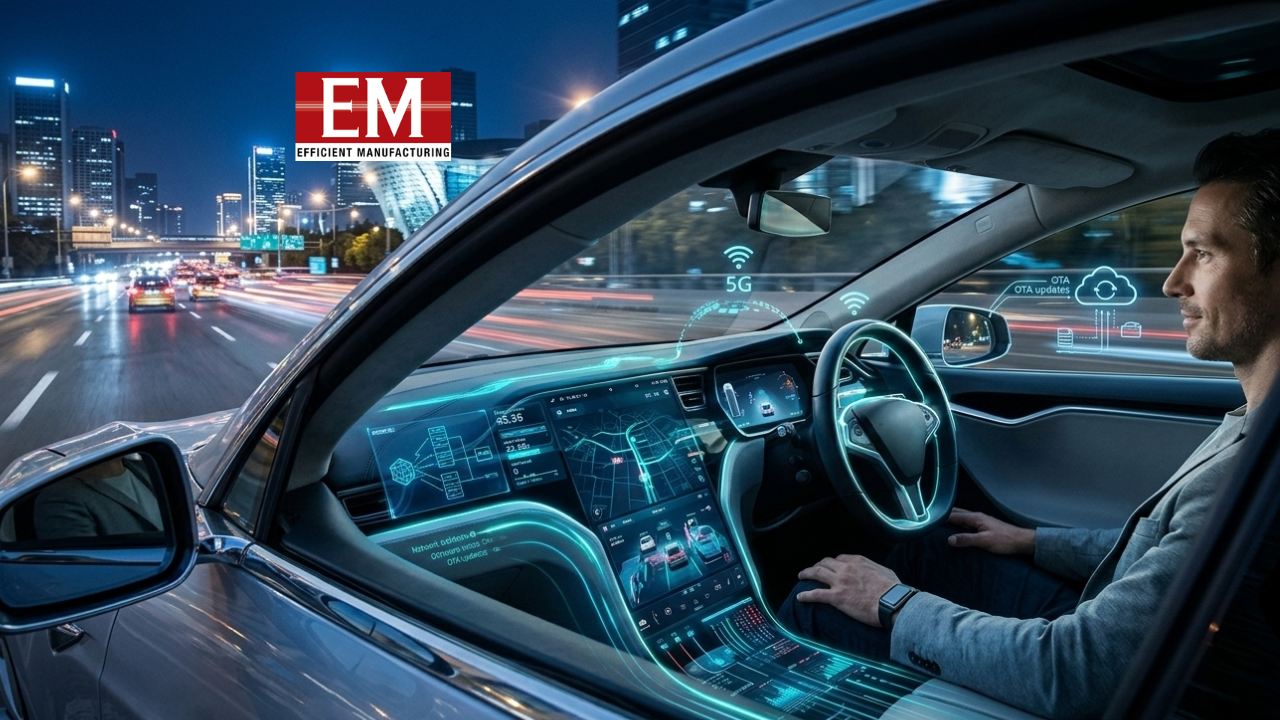
Using Over-the-Air (OTA) and Firmware-Over-the-Air (FOTA) updates, automakers can remotely upgrade vehicle software, add features, fix bugs, or improve performance without requiring physical intervention.
This capability enables continuous improvement throughout the vehicle’s lifecycle and significantly shortens innovation cycles.
Unlocking Performance Through Software
Software-defined vehicles also introduce new ways of managing vehicle performance.
For instance, certain vehicle parameters, such as power output, may be deliberately limited within a predefined operational window for safety or efficiency reasons. However, because the hardware is capable of delivering higher performance, software updates can unlock additional capabilities when needed.
In practical terms, this means drivers could temporarily activate higher performance modes, for example, enabling additional horsepower for a specific journey, through software activation or subscription-based services.
This flexible performance model allows automakers to offer customizable vehicle experiences without altering the underlying hardware.
Personalization and the Rise of Subscription Models
The SDV ecosystem also enables a new level of hyper-personalization.
Just as smartphone users download only the applications they need, vehicle owners may choose from a range of software-enabled features, such as advanced driver assistance, enhanced performance modes, or digital cockpit functions, based on their preferences.
Instead of purchasing all features upfront, users may activate selected capabilities through subscription-based models, paying only for the features they use.
This approach opens up recurring revenue streams for automakers while offering customers more flexibility and customization.
Data-Driven Ecosystems
Software-defined vehicles also generate large volumes of operational data, enabling new ecosystem partnerships and business models.
Vehicle data can support services such as:
- Usage-based insurance, where premiums are determined by driving behavior, distance traveled, or driving environments.
- Predictive maintenance, where sensors monitor vehicle health and notify users when components such as brake pads or filters require replacement.
- Location-based services, where the vehicle can interact with retail, mobility, or navigation platforms to offer personalized services.
For automakers, these data insights also provide valuable feedback about how vehicles perform in real-world conditions, enabling continuous product improvement.
Cybersecurity and Data Privacy Considerations
With greater connectivity and data generation, cybersecurity and data privacy have become critical considerations in SDV development.
Modern regulatory frameworks such as data protection laws require manufacturers to obtain user consent before using or sharing personal data. In addition, robust cybersecurity systems must be implemented to protect vehicles from unauthorized access or malicious attacks.
Ensuring secure data handling and transparent consent mechanisms will be essential for building consumer trust in connected and software-driven vehicles.
The Road Ahead
The transition to software-defined vehicles represents more than a technological upgrade, it marks a fundamental shift in how vehicles are designed, manufactured, and experienced.
By reducing hardware complexity, enabling continuous software upgrades, and creating new data-driven services, SDVs are redefining the automotive value chain. For manufacturers, this shift brings opportunities to innovate faster, optimize development costs, and establish new digital revenue streams.
For consumers, it promises vehicles that evolve over time, becoming smarter, more personalized, and more connected with every software update.
As the industry continues to embrace electrification, connectivity, and automation, software-defined vehicles are set to become the backbone of the next generation of mobility.

