



Trending Insights
PARKSON sets a new benchmark in precision Precision at Scale: How Kennametal Is Powering the Future of Fastener Manufacturing From Compliance to Prevention: How Jarsh Safety Is Redefining Industrial Protection with Smart PPE Gulf Oil Lubricants Expands Infrastructure Portfolio with Key OEM Alliances Kennametal India to Showcase Tungsten Carbide Tooling Solutions for Fasteners Industry at Fastnex 2026 Juniper Green Energy Commissions Additional 72 MWp Solar Component of Hybrid Project in Solapur, Maharashtra ACMA Press Conference H1 FY26 TM Oil Lubrication Pump Advances Precision and Reliability in Centralised Lubrication Systems HGS Introduces AMLens: Accelerating AML Investigations with Explainable AI ACMA Automechanika New Delhi 2026 set to host its Largest Edition with 800+ Exhibitors from 19 countries Brandworks Technologies announces its foray into Automotive, EV Electronics Space at CES 2026 HONEYWELL MODULAR COIL WOUND HEAT EXCHANGER TECHNOLOGY TO ACCELERATE PRODUCTION AT COMMONWEALTH LNG FACILITY Avro India Leads Waste-to-Wealth Shift with India’s Largest Flexible Plastic Recycling Unit MATTER and Niron Magnetics set a new benchmark in EV Innovation, Reveal the First-of-Its-Kind Rare-Earth-Free Variable Flux Motor Building Trust in Industrial Data: The Foundation for Responsible AI Adoption in Manufacturing ideazmeet Launches dotsupply to Support Global Supply Chain Diversification How Precision Sensors Facilitate Intelligent Lubrication for Industrial Machines Beyond Energy Efficiency: Air-Saving Ejectors Drive Sustainability and Reduce Global Warming in Industry Strategic Capital, Strong Foundations: ELV Projects’ Growth Roadmap with Institutional Backing India’s AI Moment: Why Copyright could make or break innovation RSB Group pledges to achieve 50% renewable energy adoption and 45% Emissions Cut by 2030 BenQ Launches BSH and BDH Monitor Arms: Premium Ergonomic Workspace Solutions Built by Trusted Monitor Experts Eastman Impex Strengthens Global Outreach at MITEX 2025 in Moscow QAD | Redzone Marks 20 Years in India and Unveils the Next Era of Intelligent Manufacturing at Champions of Manufacturing India 2025 SquadStack.ai Launches In-App Voice AI Assistant to Reimagine Digital Customer Journeys AI in Manufacturing: How Predictive Tech Is Redefining Quality and Cost in Consumer Durables Kirloskar Group Unveils ‘Made in Kirloskar’ Initiative, Celebrating Engineers, Engineering and the Spirit of Making EMCO Mecof MEGAMILL: the giant milling machine that combines power, precision and connectivity Rohit Markan Appointed Executive Vice President AsiaPacific For Continental’s Industrial Solutions Business The World’s Leading Industrial Fair, HANNOVER MESSE, Returns Reinvented for 2026 Cummins India Showcases its Next-Generation Power Portfolio for Infrastructure and Construction at EXCON 2025 Tata Motors leads the way with innovative, sustainable and intelligent mobility solutions at EXCON 2025 Mahindra unveils its New Mini Compactor, ‘COMPAX’ for Road Construction Industry with cutting-edge Technology Building the Future of Mobility: India’s EV Progress Through Hybrid Manufacturing and System Integration EUROBOND launches EURODUAL, becomes one of the first Indian Brands to produce Engineered Solid Panels Uno Minda Takes Full Control of EV Components JV, Announces ₹40 Crore Investment Kinetiq Rrobotics Concludes a Successful Showcase at Clean India Show 2025 — A Strong Market Debut Backed by Star Engineers’ 37-Year Legacy VIAVI and QNu Labs Partner to Accelerate Quantum-Safe Network Security Toyota Kirloskar Motor Signs MoU with Government of Nagaland to Implement Strategic CSR Initiatives Knauf India Doubles Production Capacity at Khushkhera Plant, Strengthens Manufacturing Footprint Mitsubishi Electric India to Showcase Breakthrough Power Semiconductor Technologies at PCIM India 2025 Kennametal to Showcase Advanced Earth Cutting Tools and Wear Protection Solutions at EXCON 2025 in Bengaluru Alligator Automations Unveils Its ₹40-Crore State-of-the-Art Plant to Boost Capacity and International Reach Jyoti Global Plast Unveils AeroCrop Agricultural UAS Mphasis’ Sparkle Innovation Program joins forces with Startups to accelerate next-gen innovation for clients Finolex Industries announces leadership changes, Poised for continued growth ANAND Group Appoints Mohua Mandal as Senior GM & Head of Group Communications SCG Partners with Rondo Energy To Launch ‘Southeast Asia’s First Industrial Heat Battery’, Unlocking 24-Hour Clean Energy Storage for Industry JSW Defence Commences Construction of Next-Gen UAS Facility in Hyderabad MAHLE and Jumana Al-Sibai part ways The Coolest Partnership Ever: Panasonic Brings “Captain Cool” MS Dhoni on board Saatvik Green Energy Limited achieves prestigious CII-IGBC Green Factory Building silver rating for its Ambala manufacturing facility EMO – the world’s leading trade fair for production technology to remain in Hanover How AI-Powered, Secure-by-Default Systems Can Drive Scalable Growth in Industry 4.0 Bridgestone India Expands Retail Footprint in Punjab with New Select Store in Firozpur Ultraviolette Expands To Six Locations Across Mumbai and Pune, Within 48 Hours Fronius presents the Velocity Assistant for manual MIG/MAG welding Engineering Hardware to be India’s Next Billion-Dollar Opportunity, says Hardware Industry Startup Ecosystem Report by CII, KPMG, and Synopsys HMS Networks launches new N-Tron® unmanaged industrial Ethernet switches to support mission-critical operations in rugged environments YugX Announces Strategic Partnership with MP Lifts Honeywell to help Dangote double production capabilities at Africa’s largest refinery Eastman Showcases Indian Engineering Excellence at the 138th Canton Fair Euler Motors rolls out‘Euler Prime’,a preemptive on-the-spot support solution for customers in 45+ cities BASF inaugurates the expansion of production capacity for Alkyl Polyglucosides (APGs) in Bangpakong, Thailand SKF India Strengthens Automotive Marketing Leadership Stability meets versatility – for all materials and grooving applications Success in China: Evermore Counts on Cylindrical Grinding Machines From STUDER Montra Electric Strengthens Presence in Northeast India with New Exclusive e-3W Dealership in Silchar Silmax Expands Global Footprint with New Manufacturing Facility in Bengaluru Star Engineers and ConnectM Form StarConnectM LLP to Drive the Future of Smart Mobility Vertiv Training Academy & Technology Excellence Center Launched in Pune, India, Reinforcing Dedication to Talent Development and Operational Excellence Kennametal India Board Approves INR 680 Million Capital Expenditure for Machining Solutions Group Greenfield Project Kalyani Strategic Systems Ltd (KSSL) – Securing our seas with Unmanned & Marine Systems Federal Card Services enters India with an investment of USD 250 million; first manufacturing unit coming up in Pune GHCL partners with AuthBridge to strengthen ESG compliance across the supplier ecosystem Hindustan Zinc empowers over 10 Lakh young minds through quality education in the last 5 years Novo Nordisk India partners with Emcure Pharma to commercialise Poviztra® in India as a second brand of Wegovy® BorgWarner Expands Dual Inverter Collaboration with Great Wall Motor Empowering India’s Semiconductor Revolution: Henkel’s Commitment to Sustainable Innovation SquadStack.ai Becomes World’s First Voice AI Company to Pass the Turing Test

India's Leading Magazine For Manufacturing Industries

In this article, Jagmeet Singh (VP & Global Head, Digital Engineering Advisory, Cyient) and Leelakishore Haresamudra (Divisional Senior Manager, Cyient) explore the transformative impact of AI-based simulation solvers through a comparative study on cantilever beam analysis. Their findings shed light on the performance, limitations, and business implications of AI in simulation engineering.

Introduction

Simulations in engineering, also known as simulation engineering, involve creating and using computer models and software to represent and analyse the behaviour and performance of real-world systems and phenomena. Simulation engineering can be applied to various domains and industries, such as automotive, aerospace, energy and marine engineering, to test and evaluate various aspects of products and systems, such as design, functionality, safety, and efficiency. Simulation engineering can also be used to explore and optimize various scenarios, parameters, and alternatives, to improve the quality and reliability of the products and systems.

However, simulation engineering also encounters several challenges, including complexity, uncertainty, and scalability, as well as computational and data limitations. As a result, simulation times for complex objects can range from 8–12 hours to 3–4 days. To address these challenges and enhance the capabilities and benefits of simulation engineering, leading simulation software vendors are now leveraging and integrating artificial intelligence (AI).

To gain an in-depth understanding of AI-based simulation solver capabilities, we conducted an AI-based prediction analysis on a simple cantilever beam, focusing solely on structural analysis. In parallel, we also ran simulations using a non-AI-based simulation solver to understand the variation in results.

In this study report, we will discuss the results of this comparison along with the key inferences that are noteworthy from a business adoption perspective.

Experiment Process

The step-by-step process used for conducting the experiment has been outlined in detail. The process consists of the following steps:

  1. Data Set Up
  2. Training & Testing of Models
  3. Predictions

1.  Data Set Up

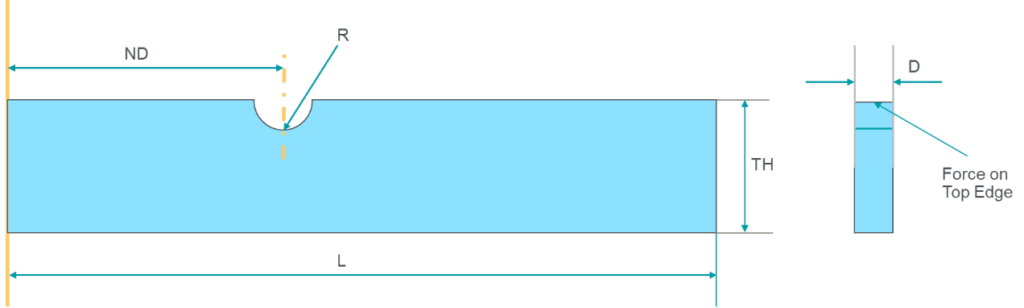
The following data set was developed for the experiment.

L = Length of the cantilever

R = Notch Radius

D = Depth of the Cantilever

TH = Thickness

ND = Notch Distance from Fixed End

We considered two key variables for the Analysis – Radius (R) and ND (Notch Distance).

With data boundaries and variables established, we initially created a database of 300+ samples for the experiment. Since AI leverages Reduced Order Models (ROMs) to enhance simulation efficiency and accuracy, only 20 models are considered as shown below:

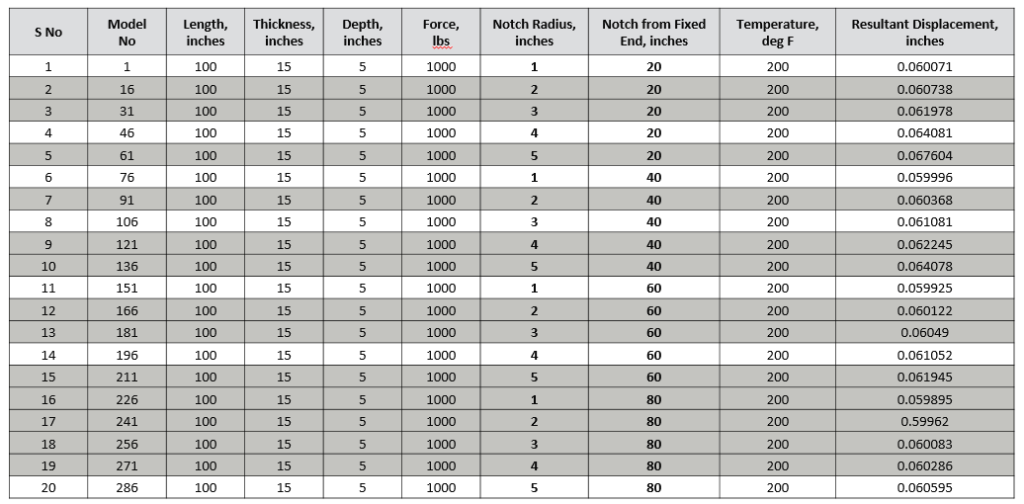
As shown in the sample data set, a range of values has been inserted for Notch Radius and ND along with the resultant displacement for the experiment.

2.  Training and Testing of Models

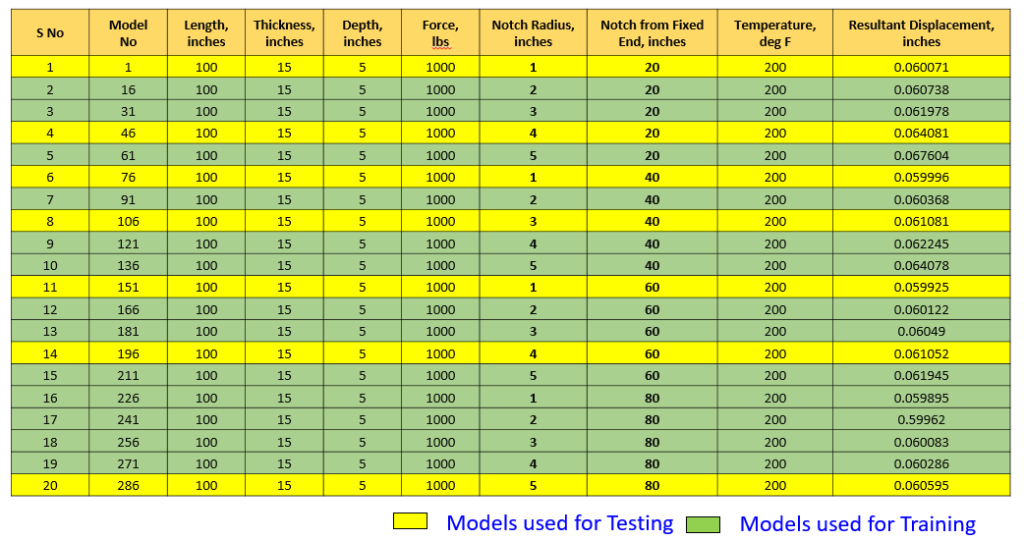
As per the general rule of thumb, 70% of the 20-sample data set was used to train the model and the rest was used for testing. The sample shown below highlights the differences between training and testing data sets.

3.  Predictions

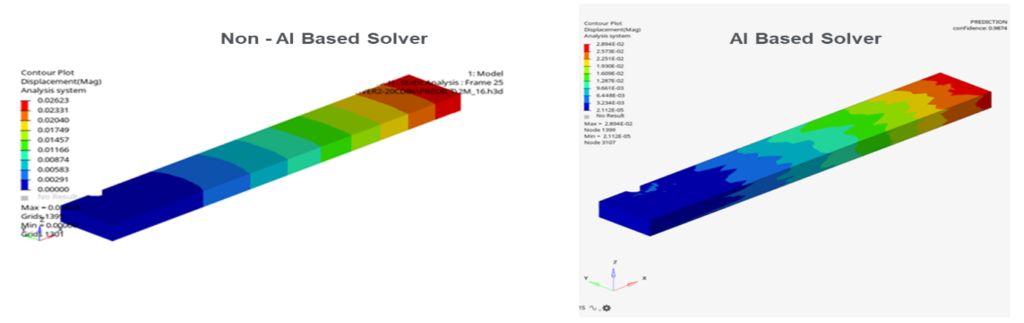
We ran the experiment on two different workbenches: one with AI-based solver and the other with a Non-AI-based solver. The results provided great insights, as shown below:

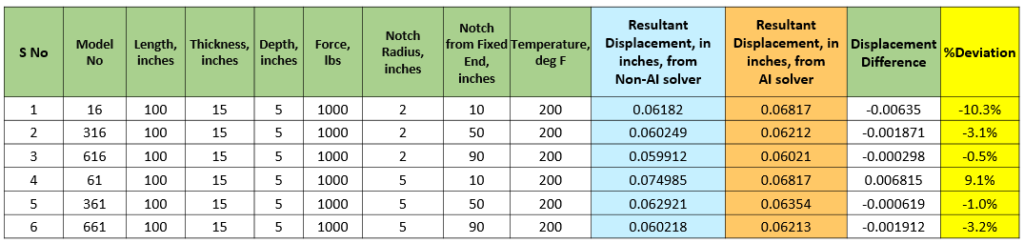
The actual workbench model output is shown to reflect the comparative models.

Key Inferences

  • Performance Efficiency: AI based simulation solvers truly add value for designers. They are 10x to 100x faster than non-AI-based simulation solver.
  • AI-Driven ROM Generation: AI can leverage machine learning techniques to enhance Reduced Order Models (ROMs) enabling faster simulations and analyses while maintaining accuracy.
  • Innovate Faster: AI-based simulation delivers rapid predictions, allowing engineering teams to test more design variations than is possible with traditional solvers.
  • Time Savings: These solvers significantly reduce or eliminate the time required to build models, speed up design processes, and lead to better design decisions.
  • Workflow Integration: AI-based simulation solvers work directly with meshes or CAD, greatly improving efficiency.
  • Predict with Confidence: AI-based simulations include a confidence score that helps detect novel shapes in your data. By evaluating geometric similarity, AI avoids unreliable predictions and ensures accuracy.
  • Precision Challenges: AI-based simulation solvers have difficulty accurately calculating discrete quantities.
  • Result Variations: The significant variation in results presents challenges for full integration.

Conclusion

Simulation engineering is experiencing significant technological advancements, and business priorities are evolving. According to a McKinsey paper on simulation engineering, there has been a notable shift in business value drivers. Faster time-to-market has become the top priority, replacing product performance, which was previously central to simulation engineering.

Furthermore, while adoption remains relatively low according to McKinsey research, the reasons vary, ranging from technology maturity and accuracy of results to the skill sets required to navigate and understand AI capabilities, among other factors.

In our study, we also observed that AI simulation solvers produced results in considerably less time. However, given that the range of variation was significantly outside industry requirements, these capabilities could not be leveraged in their current form. For example, the aerospace industry can accommodate a variation of only +1% to -1%. This is a strict, non-negotiable rule. In some cases, it may decrease, but it will definitely not increase. Similarly, the automotive industry has specific variation rules for the acceptability and validation of models.

Overall, the responsibility lies with both technology providers and the user community to collaborate and mature the technology for full business integration.

Share.
Exit mobile version