


Trending Insights
Synopsys to Showcase AI-Driven Engineering Innovation at India AI Impact Summit 2026 Adhesive Dispensing in Automotive Body Shops: Driving Safety, Efficiency, and Durability MAHLE HeatX Range+ for More Range in Winter RIR Power Electronics Limited appoints N Ramesh Kumar as Managing Director and Chief Executive Officer Euler Motors and Jio-bp partner to accelerate EV charging infrastructure for commercial electric vehicles in India ACMA welcomes the India–US Trade Interim Agreement Framework Hindustan Zinc and Jawaharlal Nehru Centre for Advanced Scientific Research Advance Zinc-Ion Battery Technology for Large-Scale Energy Storage Cobots for Precision Manufacturing ACMA Automechanika New Delhi 2026 opens, spotlighting India’s global aftermarket ambitions Addverb Unveils Elixis-W, Its First Wheeled Humanoid, and Advanced Intralogistics Solutions at LogiMAT India 2026 How India Is Building Its Semiconductor Future Enabling India’s NextChapter in Sustainable, High-Performance Manufacturing Mahindra bags its biggest ever export order; 35,000 units of LCVs to be delivered to Agrinas Pangan Nusantara, Indonesia in 2026 Manufacturing the Future: Reforms, Technology, and the Road to Viksit Bharat 2047 Landmark US-India Trade Deal Eases Tariffs, Opens New Opportunities for Indian Industry SIAM Hosts 20th Styling & Design Conclave and 18th Automotive Design Challenge LSKB Aluminium Foils and JUPALCO Host Global Aluminium Foil Industry Leaders at Sonipat Facility During GLAFCO 2026 Budget 2026 Signals a Manufacturing-Led Growth Push Across Strategic Sectors Union Budget 2026: Manufacturing Industry Sets Its Expectations Customisable E-Rickshaws: The Rising Trend in Commercial Mobility Breaking the Bandwidth Barrier: How Co-Packaged Optics is Redefining High-Speed Connectivity Eastman IMPEX Showcased Advanced Formwork, Shoring and Scaffolding Solutions at World of Concrete 2026 Adani Defence & Aerospace and Embraer announce Strategic Partnership to Establish Regional Transport Aircraft Ecosystem in India Inovance India Expands Operations with New 50,000 sq. ft. Warehouse ACMA Welcomes the India–EU Free Trade Agreement From Local to Global: India’s Aftermarket and Auto component Industry Steps into the Global Fast Lane at ACMA Automechanika New Delhi IMTEX FORMING 2026 Showcased the Future of Metal Forming and Manufacturing New Greenfield Manufacturing Facility in India Strengthens Molding Solutions’ Global Strategy Swedish Clean-Tech Innovator KonveGas to Tackle India’s Energy Storage Bottleneck Neolite ZKW holds the Commemorative Ceremony of its Automotive Lighting Products Manufacturing Facility in Pune PARKSON sets a new benchmark in precision Precision at Scale: How Kennametal Is Powering the Future of Fastener Manufacturing From Compliance to Prevention: How Jarsh Safety Is Redefining Industrial Protection with Smart PPE Gulf Oil Lubricants Expands Infrastructure Portfolio with Key OEM Alliances Kennametal India to Showcase Tungsten Carbide Tooling Solutions for Fasteners Industry at Fastnex 2026 Juniper Green Energy Commissions Additional 72 MWp Solar Component of Hybrid Project in Solapur, Maharashtra ACMA Press Conference H1 FY26 TM Oil Lubrication Pump Advances Precision and Reliability in Centralised Lubrication Systems HGS Introduces AMLens: Accelerating AML Investigations with Explainable AI ACMA Automechanika New Delhi 2026 set to host its Largest Edition with 800+ Exhibitors from 19 countries Brandworks Technologies announces its foray into Automotive, EV Electronics Space at CES 2026 HONEYWELL MODULAR COIL WOUND HEAT EXCHANGER TECHNOLOGY TO ACCELERATE PRODUCTION AT COMMONWEALTH LNG FACILITY Avro India Leads Waste-to-Wealth Shift with India’s Largest Flexible Plastic Recycling Unit MATTER and Niron Magnetics set a new benchmark in EV Innovation, Reveal the First-of-Its-Kind Rare-Earth-Free Variable Flux Motor Building Trust in Industrial Data: The Foundation for Responsible AI Adoption in Manufacturing ideazmeet Launches dotsupply to Support Global Supply Chain Diversification How Precision Sensors Facilitate Intelligent Lubrication for Industrial Machines Beyond Energy Efficiency: Air-Saving Ejectors Drive Sustainability and Reduce Global Warming in Industry Strategic Capital, Strong Foundations: ELV Projects’ Growth Roadmap with Institutional Backing India’s AI Moment: Why Copyright could make or break innovation RSB Group pledges to achieve 50% renewable energy adoption and 45% Emissions Cut by 2030 BenQ Launches BSH and BDH Monitor Arms: Premium Ergonomic Workspace Solutions Built by Trusted Monitor Experts Eastman Impex Strengthens Global Outreach at MITEX 2025 in Moscow QAD | Redzone Marks 20 Years in India and Unveils the Next Era of Intelligent Manufacturing at Champions of Manufacturing India 2025 SquadStack.ai Launches In-App Voice AI Assistant to Reimagine Digital Customer Journeys AI in Manufacturing: How Predictive Tech Is Redefining Quality and Cost in Consumer Durables Kirloskar Group Unveils ‘Made in Kirloskar’ Initiative, Celebrating Engineers, Engineering and the Spirit of Making EMCO Mecof MEGAMILL: the giant milling machine that combines power, precision and connectivity Rohit Markan Appointed Executive Vice President AsiaPacific For Continental’s Industrial Solutions Business The World’s Leading Industrial Fair, HANNOVER MESSE, Returns Reinvented for 2026 Cummins India Showcases its Next-Generation Power Portfolio for Infrastructure and Construction at EXCON 2025 Tata Motors leads the way with innovative, sustainable and intelligent mobility solutions at EXCON 2025 Mahindra unveils its New Mini Compactor, ‘COMPAX’ for Road Construction Industry with cutting-edge Technology Building the Future of Mobility: India’s EV Progress Through Hybrid Manufacturing and System Integration EUROBOND launches EURODUAL, becomes one of the first Indian Brands to produce Engineered Solid Panels Uno Minda Takes Full Control of EV Components JV, Announces ₹40 Crore Investment Kinetiq Rrobotics Concludes a Successful Showcase at Clean India Show 2025 — A Strong Market Debut Backed by Star Engineers’ 37-Year Legacy VIAVI and QNu Labs Partner to Accelerate Quantum-Safe Network Security Toyota Kirloskar Motor Signs MoU with Government of Nagaland to Implement Strategic CSR Initiatives Knauf India Doubles Production Capacity at Khushkhera Plant, Strengthens Manufacturing Footprint Mitsubishi Electric India to Showcase Breakthrough Power Semiconductor Technologies at PCIM India 2025 Kennametal to Showcase Advanced Earth Cutting Tools and Wear Protection Solutions at EXCON 2025 in Bengaluru Alligator Automations Unveils Its ₹40-Crore State-of-the-Art Plant to Boost Capacity and International Reach Jyoti Global Plast Unveils AeroCrop Agricultural UAS Mphasis’ Sparkle Innovation Program joins forces with Startups to accelerate next-gen innovation for clients Finolex Industries announces leadership changes, Poised for continued growth ANAND Group Appoints Mohua Mandal as Senior GM & Head of Group Communications SCG Partners with Rondo Energy To Launch ‘Southeast Asia’s First Industrial Heat Battery’, Unlocking 24-Hour Clean Energy Storage for Industry JSW Defence Commences Construction of Next-Gen UAS Facility in Hyderabad MAHLE and Jumana Al-Sibai part ways

India's Leading Magazine For Manufacturing Industries

… by JG Bhuvanesh, Business Line Manager – Industrial Assembly Solutions, Industrial Technique, Atlas Copco (India)

Today, the body-in-white stage represents a critical point in modern automotive manufacturing for defining the structural integrity of a vehicle. At this stage, sheet metal components are combined into a chassis. This forms the basis for crash performance, vehicle rigidity, noise, vibration, and long-term durability. With automakers’ unending quest for lighter, safer, more efficient vehicles, adhesive dispensing has emerged as one of today’s most important technologies for the assistance of traditional welding and mechanical fastening techniques.

Evolving Challenges in the Body Shop

Modern cars have a mixed material approach for reducing weight while not sacrificing safety. The use of many different types of materials introduces some challenges when they are bonded together because the adhesive must provide strength and stability between them. Corrosion resistance at hem flange joints is another requirement for any adhesive used to bond different types of automotive components. Furthermore, adhesives need to be durable and able to perform under repeated dynamic forces.

A critical additional requirement of adhesive solutions is to dampen the effect of noise, etc., by providing an elastic bond where they connect. Historically, certain automobile body parts, such as doors, roofs, rear-end structures, or compartments, have been made with a rigid connection. Under the current assembly requirements for automobile manufacturers, there is not enough time available to assemble vehicles using this method. Therefore, adhesive solutions need to be both accurately constructed and to hold their accuracy consistently over high-volume production.

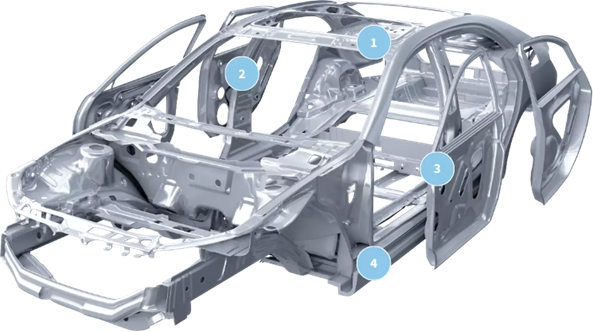
Adhesive Applications Across Key Body Shop Processes

Automotive body shops apply adhesives in various processes, each with unique technical requirements:

  1. Roof structures: Roof structures are designed to meet high aesthetic and functional standards, including noise reduction and insulation. Made from materials like aluminum, steel, plastic, or carbon, each with unique properties, the challenge is to ensure a stable, durable, and high-performance structure. 
  2. Framing: Framing joins the side walls with the roof frame and underbody, focusing on crash safety, lightweight design, and short production times. Customized bonding solutions enhance crash safety while minimizing weight. 
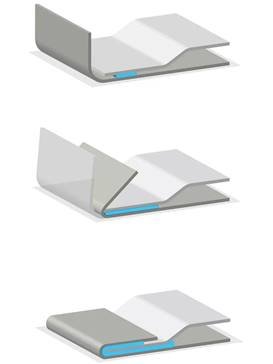
  3. Closure parts: Closure parts like doors, hoods, and bumpers create stable connections between components, optimizing crash safety, vehicle rigidity, and corrosion protection. Seam bonding is a complex technique used in this process.
  4. Underbody: The underbody forms the basis for key vehicle components like the chassis and engine, requiring a strong structure. This is achieved by joining different materials using techniques like bonding and spot welding. Ensuring a safe and healthy working environment is crucial.

Techniques in Modern Adhesive Dispensing

Adhesive application methods have evolved to meet these challenges, with several techniques gaining prominence:

  • Bead application: The adhesive beads are spaced evenly in an elongated form, as the adhesive is required to bond in a controlled manner, especially on flat surfaces.
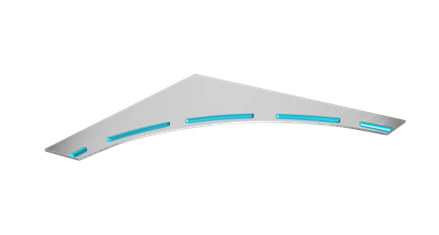
  • Stitch bead application: The adhesives are applied in select areas or in intervals in order to save adhesive and make bonds stronger at specific points.
  • Swirl application: The adhesive is applied in circular or swirl motions. This type of application takes place when one wants to apply adhesive over large portions, hence it is very effective in adhesive bonding processes. This is most helpful when applying adhesive on irregularly shaped surfaces.
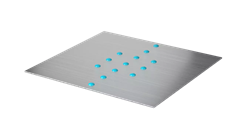
  • Multi-Dot application: This process uses small dots of adhesives to cover the surface. This method of applying adhesives has good control over positioning and amount and is ideal for applications requiring precision.

Each technique has advantages depending on the component geometry, load requirements, and production speed. High-volume manufacturing also demands systems capable of precise dosing and repeatable performance. As vehicle architectures have moved towards lightweight platforms, electric vehicles, and modular body designs, adhesive dispensing has become more of a strategic enabler to manufacturers than just a complementary joining process. Currently, adhesives have been expected to perform multiple functions: as structural reinforcers, sealers, anti-vibration dampeners, and corrosion protectors, and to accomplish all of these different types of functions with one application of adhesive, decreasing the number of components needed for the assembly and supporting flexible manufacturing systems.

Structural, Sealing, and Anti-Flutter Applications

  • Structural Bonding: By providing support to joints to withstand stress, structural adhesive bonding enhances the safety of vehicles in a crash, holds them rigid, and allows them to be made lighter. The processes involve framing, underbody components, and attaching supplemental components.
  • Sealing: Seals provide a barrier against water, air, and contamination. This helps create a corrosion-resistant and NVH-performant joint. The precision bead application is very important for a complete fill.
  • Anti-Flutter: Doors, hoods, and trunk lids need elastic bonding to prevent resonant oscillations between the inner and outer panels. Methods of multi-dot or elastic bead application can be regarded as damping mechanisms for sound and maintaining panel integrity.

Trends Shaping Adhesive Dispensing in Automotive Manufacturing

Several trends are transforming the role of adhesives in body shops:

  • Lightweighting: Adhesives have made the bonding of mixed materials possible without adding mass, hence supporting fuel efficiency and EV battery range.
  • Automation & Cobots: Automated distribution systems and cobots ensure precision, reduce cycle time, and enhance repeatability.
  • Sustainability: Adhesives with low environmental impact, recyclable materials, and energy-efficient curing processes are becoming of increasing importance.
  • Advanced Testing & Simulation: Digital solutions let engineers compute the structure for stress distribution, curing time, and NVH performance to optimize the usage of adhesives before production.

In addition to increased productivity, a controlled adhesive dispensing system also contributes to sustainability efforts. This is achieved through reduced material use, less exposure to the material for the operators, and a cleaner production environment. This is important as OEMs move towards embracing global standards in production.

Supporting Innovation in Adhesive Dispensing

Although there is rapid technological development for high-performing adhesive technology, the necessity to apply this technology requires specialized competency as well as validation and optimization. Manufacturers such as Atlas Copco are developing very advanced technology to dispense adhesives and provide expert advice to manufacturers in order to improve the quality and efficiency of the manufacturers’ manufacturing processes, validate the adhesive materials and technologies being used, and maximize efficiency and effectiveness in the operation of their factories.

Share.
Exit mobile version