



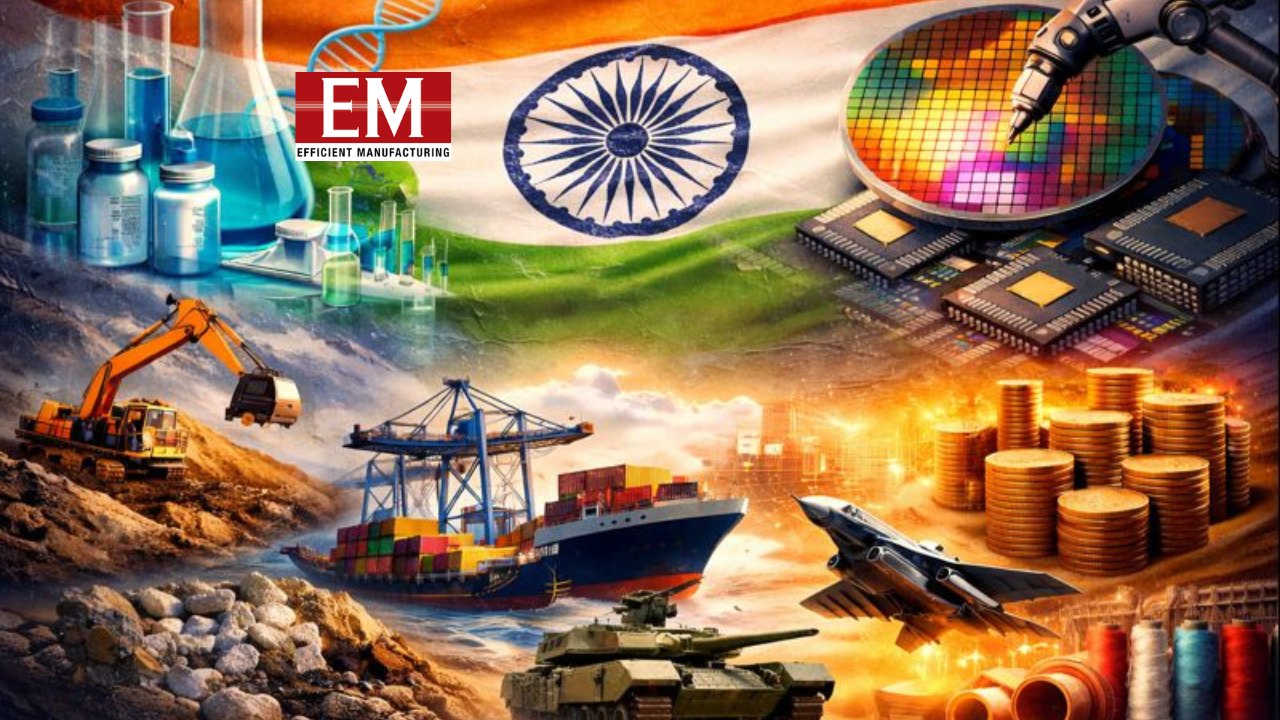
The Union Budget has sent a strong and unambiguous signal: manufacturing will remain central to India’s growth story, with targeted investments across biopharma, semiconductors, electronics, minerals, chemicals, textiles and logistics infrastructure. From high-tech to traditional industries, the announcements reflect a dual focus—building global-scale capabilities while strengthening domestic value chains.
A major highlight is the launch of Biopharma SHAKTI with an outlay of ₹10,000 crore over five years, aimed at positioning India as a global biopharma manufacturing hub. Complementing this, the India Semiconductor Mission 2.0 will focus on equipment and materials manufacturing, full-stack Indian IP design, and supply-chain resilience. The push for electronics manufacturing is further reinforced with the Electronics Components Manufacturing Scheme seeing its outlay increased to ₹40,000 crore, underlining the government’s intent to deepen localisation and scale up high-value manufacturing.
Resource security and industrial infrastructure also feature prominently. The proposed Rare Earth Corridors across mineral-rich states such as Odisha, Kerala, Andhra Pradesh and Tamil Nadu are expected to boost mining, processing, research and manufacturing in critical materials. In chemicals, a new scheme will support states in setting up three dedicated Chemical Parks on a cluster-based, plug-and-play model. The logistics ecosystem gets a boost with a ₹10,000 crore Container Manufacturing Scheme over five years, aimed at building a globally competitive domestic container industry.
Textiles and traditional industries are not left behind. An integrated programme with five components for the textile sector, alongside Mega Textile Parks to be set up through a challenge mode, signals renewed focus on scale, competitiveness and exports. The “Mahatma Gandhi Gram Swaraj” initiative aims to strengthen khadi, handloom and handicrafts with global market linkage and branding, while a dedicated initiative for sports goods seeks to promote manufacturing, R&D, and innovation in equipment design and material sciences.
Industry leaders have welcomed the Budget’s clear manufacturing thrust, calling it a decisive step towards building resilient supply chains, accelerating high-value production, and positioning India as a global manufacturing hub.


Baba Kalyani, CMD, Bharat Forge
“The Union Budget 2026 reflects strong and visionary leadership, anchored in policy continuity, fiscal discipline and a clear focus on building long-term national capabilities. I congratulate the Hon’ble Finance Minister on her ninth successive Budget, which balances macroeconomic stability with investment-led growth. The multi-pronged growth framework and three kartavyas reaffirm the commitment to a competitive, inclusive and future-ready economy.
The Budget reinforces the government’s bet on manufacturing, with strategic focus on modern infrastructure, semiconductors through ISM 2.0, and rare-earth corridors to strengthen domestic supply chains. The emphasis on green competitiveness, defence modernisation and technology-led self-reliance sends a strong signal to industry and investors alike. The thrust on data centres, cloud services, and university–industry clusters, alongside AI-led productivity, will further enhance India’s global competitiveness. Overall, the Budget provides industry the confidence to invest, innovate and partner in building a resilient and globally competitive Indian economy.”


Vinod Aggarwal, MD & CEO, VE Commercial Vehicles
“The Union Budget 2026 sets out a clear and purposeful roadmap to strengthen India’s growth trajectory and advance the vision of Viksit Bharat. With a clear focus to build capability in crucial areas, the budget reinforces the foundations of the automotive and commercial vehicle industry. The continued focus on capital expenditure, with ₹12.2 lakh crore allocated for infrastructure, will play a critical role in sustaining demand for trucks, buses, and logistics assets that underpin economic activity nationwide. The Budget’s emphasis on developing Rare Earth Mineral Corridors across Odisha, Kerala, Andhra Pradesh, and Tamil Nadu marks a strategic step toward securing critical inputs for electric motors and advanced components. This will reduce import dependence, strengthen domestic value chains, and bolster India’s long-term competitiveness in high-technology mobility. On the clean mobility front, the continuation of duty exemptions on capital goods for battery manufacturing, alongside targeted incentives for localized processing, sends a strong signal of intent. These measures are instrumental in accelerating EV adoption while building a cost-efficient battery ecosystem—crucial for improving the Total Cost of Ownership and driving wider commercial viability.
Overall, the Budget strikes the right balance between near-term industry confidence and long-term capacity building, reinforcing India’s position as a resilient, self-reliant, and globally competitive manufacturing hub.”


Abhishek Shrivastava, MD, IMEA, The Lubrizol Corporation
“The Union Budget 2026–27 sends a strong and timely signal for India’s industrial growth journey. The unmissable focus on domestic manufacturing is reflected through continued support for production ecosystems, infrastructure expansion, and skill development, which will significantly help elevate Indian manufacturing to global standards. For the chemical industry, the government’s commitment to rationalising and lowering customs duties on chemical raw materials is particularly important, as it will help reduce costs, strengthen supply chains, and enable Indian manufacturers to compete more equitably at the global level.
Additionally, the focus on logistics and innovation-led growth further reinforces confidence in long-term investments across sectors. The Budget’s balanced approach, addressing structural bottlenecks while promoting higher value-added manufacturing supports sustainable growth and resilience. The recent clarity on the GST intermediary ruling also brings much-needed certainty for cross- border services, aiding ease of doing business. Overall, this is a forward-looking budget that aligns industry aspirations with the larger goal of sustainable nation building. Timely and effective execution of the announced measures will be key to unlocking their full impact on businesses and the economy.”


Vishal Sharma, Executive Director and Chief Executive Officer, Godrej Industries (Chemicals)
“Budget 2026-27 ramps up the government’s push to make Indian manufacturing stand out, and for the chemicals sector, it’s a strong step forward. The reforms around extra funding for R&D is big for chemical sector where progress depends on constant innovation, especially in advanced materials, specialty chemicals, and fresh sustainable solutions.
While the budget lays out a clear strategy, the industry would have welcomed stronger fiscal incentives for capital-heavy green tech, quicker clarity on the new labour codes, and more focused support for exports. Moves like these would help chemical companies attract more investment and compete faster on the global stage. Still, the ‘Reform Express’ narrative inspires confidence and provides a solid platform for sustainable, technology-driven manufacturing growth in India.”


Subbu Venkatachalam, Head of Defence & Aerospace, Carborundum Universal Limited
In my view, today’s Budget announcement gave a timely & vital boost to the entire defence manufacturing ecosystem. The most significant one was the recognition of critical minerals and materials science as core enablers of strategic, frontier sectors like aerospace and defence. The proposal to set up Rare Earth Corridors in critical mineral belts will ensure that domestic defence manufacturers and OEMs can bank on a robust ecosystem for mining, processing, research and manufacturing within the country. MSMEs play a key role in manufacturing for the defence sector. Supporting them with the ₹10,000 crore SME Growth Fund and the ₹2,000 crore top-up of the Self-Reliant India Fund will not only help them maintain liquidity and hedge risk but also enable them to augment their capabilities to innovate for the sector. The creation of planned academic zones around major industrial corridors, along with a focus on dedicated research and training centres, will not only enable closer research-to-field collaboration & acceleration, but also foster a workforce skilled in future tech.
Customs duty exemption for raw materials imported to manufacture MRO-related parts and the overall push to deepen domestic manufacturing of aviation components and parts, including for defence-related needs, is a much-needed move towards India’s Viksit Bharat and self-reliance goals. With an expansion in the budgetary allocation towards defence, from FY 2025-26, we look forward to a year of intense activity in every area of defence modernisation.


Pawan Kumar Garg, Chairman & Joint Managing Director, Fujiyama Power Systems
“Union Budget 2026 signals a strong strategic thrust towards technology-led growth and sustainable energy transformation. The launch of India Semiconductor Mission 2.0 with significant support for industry-led R&D and manufacturing is a landmark step in advancing India’s semiconductor ecosystem and strengthening our global competitiveness. At the same time, the renewed focus on solar and renewable energy value chains in the broader budget framework underscores the government’s commitment to achieving clean energy goals and enhancing energy security while reflecting the industry’s call for deeper support across solar infrastructure, grid readiness, storage, and domestic manufacturing. These combined priorities will not only accelerate India’s technology and sustainability ambitions but also unlock meaningful opportunities for innovation and industrial growth. We are optimistic about contributing to this dual momentum in semiconductors and the clean energy transition.”


Sebi Joseph, President, Otis India
“The Honourable Finance Minister Smt. Nirmala Sitharaman has presented a growth-oriented budget delivering a powerful push to infrastructure, manufacturing, and technology, boosting job creation. The vertical transportation industry would benefit from the acceleration of the momentum of construction and real estate growth.
Development of city economic regions, establishment of seven high-speed rail corridors, new schemes for construction and infrastructure equipment manufacturing, proposal of infrastructural risk guarantee fund, massive outlay for semiconductor, rare earth and electronics industries transformation are commendable. At Otis, we welcome the Budget’s forward-looking vision and remain committed to supporting India’s infrastructure ambitions. Through continuous innovation and digital integration, we are proud to help move people and the nation forward- safely and swiftly.”


Vivek Lohia, Managing Director, Jupiter Wagons
“The ₹2.77 lakh crore allocation for railways, alongside sustained capital expenditure, provides continuity and planning confidence for the rail manufacturing ecosystem. Measures announced in the Budget, such as the one-time facilitation for eligible manufacturing units in Special Economic Zones to sell into the Domestic Tariff Area at concessional duty, are particularly relevant in the context of global trade disruptions, as they help improve capacity utilisation while maintaining a level playing field. Equally important are steps to simplify customs processes and reduce intervention, which will support faster movement of goods and greater trade certainty. The proposed ₹10,000 crore scheme for container manufacturing, supported by production-linked incentives for containers and Battery Energy Storage Systems, will help build scale in domestic manufacturing. As a company that has been at the forefront of container manufacturing, we see this as a boost which can significantly accelerate production capacity and localisation. The extension of basic customs duty exemptions to capital goods used in lithium-ion cell manufacturing for BESS will further improve project viability and accelerate localisation.
Alongside the announcement of seven new high-speed rail corridors and continued investment in freight corridors and logistics infrastructure, these measures strengthen the manufacturing-logistics link and reinforce India’s position in global supply chains, advancing the broader ambition of Viksit Bharat through execution-led growth.”


Jalaj Gupta, Managing Director, Montra Electric
“This year’s Union Budget lays a strong foundation for India’s clean mobility and advanced manufacturing ambitions. From supporting lithium-ion cell manufacturing and rare earth processing to strengthening semiconductor and electronics ecosystems through ISM 2.0 and enhanced component schemes, the government is enabling a truly integrated EV supply chain. These initiatives will help deepen localisation, develop skilled talent, and reinforce India’s position as a global hub for sustainable mobility and high-technology manufacturing.”


Sanjay Choudhari, Chairman, SBL Energy
“The Union Budget 2026-2027 points to a clear strategic response to the growing global trade tensions and supply-chain vulnerabilities. By establishing dedicated rare earth corridors across mineral-rich states and supporting downstream processing, research, and manufacturing, the government is addressing one of India’s most critical dependencies – access to strategic materials dominated by global monopolies. This initiative not only strengthens domestic capabilities but also provides a significant boost to the mining sector, incentivising exploration, commercial-scale extraction, and integration with downstream industries.
Apart from this, the parallel push to strengthen manufacturing across priority sectors, including the creation of dedicated chemical parks, reflects a shift from fragmented capacity to integrated industrial ecosystems. To sum it all up, these measures reduce import dependence, build supply-chain resilience, and position India as a more reliable and competitive player in global manufacturing networks.”