

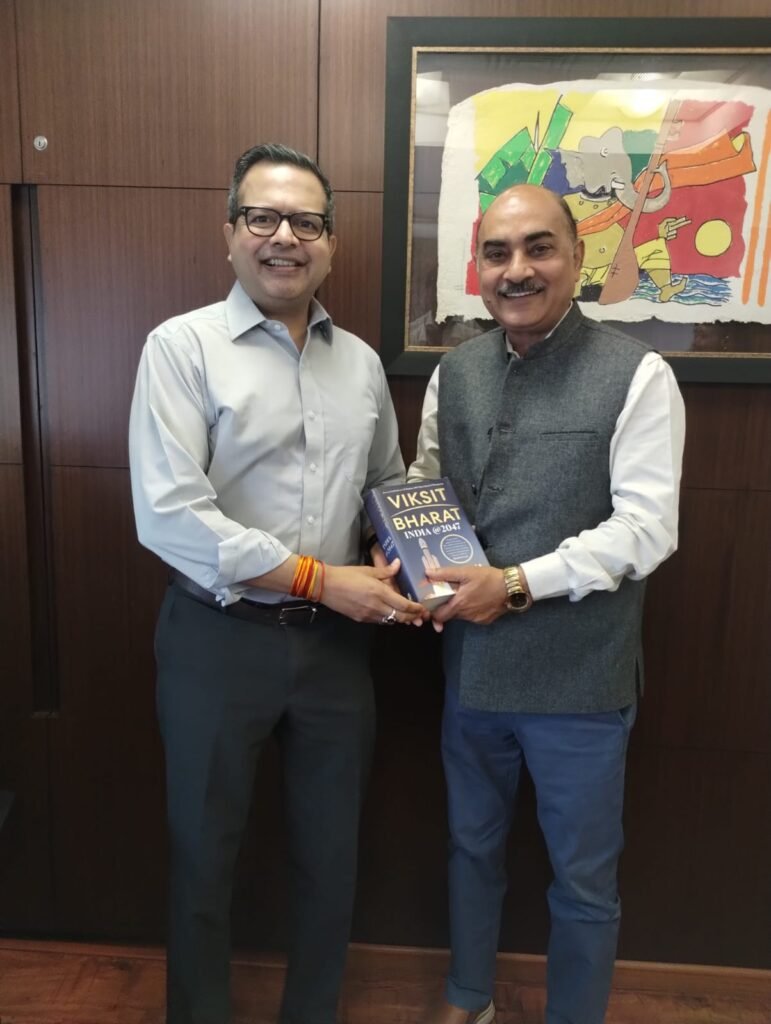
Aditya Pittie’s Viksit Bharat India @2047 lays out an ambitious yet deeply practical blueprint for transforming India into a $30+ trillion economy, with manufacturing positioned as the central engine of jobs, productivity, and global competitiveness. In this interview, Pittie explains why advanced manufacturing, automation, and Industry 4.0 must become India’s new baseline—not just to scale output, but to build capability, quality, and export strength. From reform priorities and digital public infrastructure to sustainability, inclusion, and the everyday actions leaders and MSMEs can take, he outlines how India can move decisively from “Make in India” to “Make in India for the World.”

- Your book lays out a roadmap for India becoming a $30+ trillion economy by 2047. In this journey, what role do you foresee the manufacturing sector playing, especially in areas like advanced manufacturing, automation, and Industry 4.0?
In Viksit Bharat India@2047, manufacturing is not just a sector-it is the multiplier that converts India’s demographics into productive, exportable value. A jobs + productivity engine: Manufacturing creates large-scale employment across skill levels and raises productivity when it modernizes and automates and gets technology enabled. A trade-balancing engine: A $30+ T economy must be globally integrated. Manufacturing is the most reliable way to scale exports, deepen value addition, and reduce strategic import dependence.
Advanced manufacturing as the “quality leap”: India’s opportunity is not only “more factories” but better factories-precision engineering, electronics, semiconductors, EV supply chains, defence/aerospace, med-tech, specialty chemicals, and industrial machinery.
Automation as a competitiveness necessity: Automation should be framed as augmentation-higher throughput, consistent quality, safer workplaces, and higher wages through higher productivity. Industry 4.0 as the new baseline: Sensors + data + digital twins + predictive maintenance + robotics + Al scheduling = lower downtime, better energy efficiency, and faster iteration. For India, Industry 4.0 is how we move from “cost advantage” to capability advantage. It also serves as a democratizing tool, allowing MSME’s the same level of tech and quality as large companies.
Bottom line: Manufacturing must become India’s scale-and-sophistication platform a bridge from “Make in India” to “Make in India for the World.”
2. According to you, which specific reforms would most accelerate India’s emergence as a global manufacturing hub over the next decade?
If we want speed and scale, the reforms must reduce friction, reduce cost of capital, and increase predictability.
The “Top 8” accelerators:
1. Stable, low-friction regulatory architecture
Decriminalize minor compliance, reduce inspector raj via risk-based inspections, simplify filings, faster approvals.
2. Land + logistics + power as a plug-and-play bundle
Industrial parks with clear titles, single-window utilities, predictable tariffs, fast evacuation, and common testing.
3. Labour flexibility with strong worker security
Easier formal hiring + skilling + portable social security, reward firms that formalise employment. This has largely been achieved with the latest 4 New Labour Codes.
4. Trade facilitation + faster customs
“Time is money” for exporters: faster clearances, lower documentation burden, world-class ports, predictable duty regimes.
5. Cost of capital and long-tenure credit for manufacturing
Deepen credit guarantees, strengthen development finance (SIDBI-like scale across segments), and expand bond/credit markets for mid-caps.
6. A national quality and standards mission
Testing labs, certification capacity, metrology, quality culture: compete on reliability, not only price.
7. R&D + design incentives (not only production incentives)
Move from assembly to IP: support for design, prototyping, patents, and industry-academia labs.
8. MSME scale-up reforms
- Incentivize consolidation, clusters, shared services, technology upgrade financing, and procurement that rewards quality + delivery. SIDBI scheme.
- A simple lens: Remove bottlenecks across Factor Markets (land/labour/capital) + Logistics + Quality + Innovation.
3. The book touches upon digital innovation as a key pillar for Viksit Bharat. How should India’s manufacturing ecosystem leverage AI, IoT, and digital public infrastructure to enhance productivity, efficiency, and global competitiveness?
India has a unique advantage: Digital Public Infrastructure (DPI) can create a “low-cost digital spine” for factories and supply chains, and the digital rails can accelerate manufacturing.
How manufacturing should leverage this:
- Al for shopfloor productivity
Demand forecasting, production planning, yield optimization, anomaly detection, predictive maintenance, quality inspection (computer vision).
- IoT for real-time visibility
Sensor-based monitoring of machines, energy, temperature, vibration-reduce downtime and waste; enable traceability.
- DPI for frictionless operations
- Digital identity + consent-based data sharing + instant payments + e-invoicing + account aggregation can support:
- Faster MSME credit decisions (cash-flow based lending)
- Invoice discounting and supply-chain finance
- Lower transaction costs and better compliance
- Digital twins and simulation
Reduce time-to-market; test lines virtually before capex; improve throughput without constant trial-and-error.
- Cybersecurity as core infrastructure
As factories digitize, securing OT/IT systems becomes essential for safety, continuity, and export compliance.
The big idea: AI + IoT + DPI should convert Indian manufacturing from “low visibility, high variability” to “high visibility, low variability.” That’s what global customers pay for.
4. Sustainability and inclusive growth are central themes in your vision. What policies or industry practices do you believe are essential for ensuring that India’s manufacturing growth is both environmentally responsible and socially inclusive?
Sustainable manufacturing is now a market-access requirement (for customers, regulators and financiers) and an India-first necessity.
Environmental responsibility
- Energy transition at factory level: accelerate renewables, storage, and efficiency, scale audits and payback-linked financing for MSMEs.
- Circular economy: design for recyclability, repairability, reuse; extended producer responsibility; materials recovery ecosystems.
- Water stewardship: water audits, recycling, ZLD where feasible, watershed-linked industrial planning.
- Clean logistics: modal shift (rail/coastal), EV fleets for last mile, smarter routing.
Social inclusion
- Formalization with dignity: safe workplaces, predictable wages, social security, grievance systems.
- Skilling at scale: apprenticeship-led skilling, micro-credentials aligned to Industry 4.0 roles (maintenance techs, PLC, robotics ops, quality engineers).
- MSME inclusion: shared testing labs, common tool rooms, cluster-based upgrades so small firms don’t get locked out by compliance costs.
- Regional balance: manufacturing corridors that lift Tier-2/3 cities-growth that is geographically distributed.
Core principle: Sustainability + inclusion are not “extras” they are competitiveness.
5. What actions can industry leaders, MSMEs, and manufacturing professionals take today to meaningfully accelerate the Viksit Bharat 2047 mission?
This is where Viksit Bharat becomes a movement, not a slogan.
For Industry Leaders (large firms)
- Build MSME supplier capability: share forecasts, standardize specs, train suppliers on quality/lean, and provide faster payments.
- Adopt a “net export mindset”: design products for global standards from day one; invest in certification and compliance.
- Lead on sustainability and traceability: make supply chains future-proof and finance-friendly.
- Invest in R&D + design: create India-based product platforms, not just plants.
For MSMEs
- Digitize the basics: ERP-lite, e-invoicing, inventory visibility, quality logs this unlocks cheaper credit and export readiness.
- Move from job-work to value-add: specialize, build IP, improve tolerances, invest in testing and process control. Join clusters/consortia: shared labs, shared procurement, shared logistics; scale by collaboration.
- Strengthen working capital discipline: invoice cycles, collections, inventory turns-profit without cash is fragile.
For Manufacturing Professionals
- Become Industry 4.0 bilingual: production + data. Learn analytics, automation basics, quality systems, energy management.
- Operational excellence as a career moat: TPM, Six Sigma, lean, safety, maintenance, and reliability.
- Champion productivity with people: automation that upskills, not replaces; safety and quality culture.
For all stakeholders
- Treat manufacturing as nation-building: quality, punctuality, productivity, and integrity-these are national competitiveness traits.