






Trending Insights
Union Budget 2026: Manufacturing Industry Sets Its Expectations Customisable E-Rickshaws: The Rising Trend in Commercial Mobility Breaking the Bandwidth Barrier: How Co-Packaged Optics is Redefining High-Speed Connectivity Eastman IMPEX Showcased Advanced Formwork, Shoring and Scaffolding Solutions at World of Concrete 2026 Adani Defence & Aerospace and Embraer announce Strategic Partnership to Establish Regional Transport Aircraft Ecosystem in India Inovance India Expands Operations with New 50,000 sq. ft. Warehouse ACMA Welcomes the India–EU Free Trade Agreement From Local to Global: India’s Aftermarket and Auto component Industry Steps into the Global Fast Lane at ACMA Automechanika New Delhi IMTEX FORMING 2026 Showcased the Future of Metal Forming and Manufacturing New Greenfield Manufacturing Facility in India Strengthens Molding Solutions’ Global Strategy Swedish Clean-Tech Innovator KonveGas to Tackle India’s Energy Storage Bottleneck Neolite ZKW holds the Commemorative Ceremony of its Automotive Lighting Products Manufacturing Facility in Pune PARKSON sets a new benchmark in precision Precision at Scale: How Kennametal Is Powering the Future of Fastener Manufacturing From Compliance to Prevention: How Jarsh Safety Is Redefining Industrial Protection with Smart PPE Gulf Oil Lubricants Expands Infrastructure Portfolio with Key OEM Alliances Kennametal India to Showcase Tungsten Carbide Tooling Solutions for Fasteners Industry at Fastnex 2026 Juniper Green Energy Commissions Additional 72 MWp Solar Component of Hybrid Project in Solapur, Maharashtra ACMA Press Conference H1 FY26 TM Oil Lubrication Pump Advances Precision and Reliability in Centralised Lubrication Systems HGS Introduces AMLens: Accelerating AML Investigations with Explainable AI ACMA Automechanika New Delhi 2026 set to host its Largest Edition with 800+ Exhibitors from 19 countries Brandworks Technologies announces its foray into Automotive, EV Electronics Space at CES 2026 HONEYWELL MODULAR COIL WOUND HEAT EXCHANGER TECHNOLOGY TO ACCELERATE PRODUCTION AT COMMONWEALTH LNG FACILITY Avro India Leads Waste-to-Wealth Shift with India’s Largest Flexible Plastic Recycling Unit MATTER and Niron Magnetics set a new benchmark in EV Innovation, Reveal the First-of-Its-Kind Rare-Earth-Free Variable Flux Motor Building Trust in Industrial Data: The Foundation for Responsible AI Adoption in Manufacturing ideazmeet Launches dotsupply to Support Global Supply Chain Diversification How Precision Sensors Facilitate Intelligent Lubrication for Industrial Machines Beyond Energy Efficiency: Air-Saving Ejectors Drive Sustainability and Reduce Global Warming in Industry Strategic Capital, Strong Foundations: ELV Projects’ Growth Roadmap with Institutional Backing India’s AI Moment: Why Copyright could make or break innovation RSB Group pledges to achieve 50% renewable energy adoption and 45% Emissions Cut by 2030 BenQ Launches BSH and BDH Monitor Arms: Premium Ergonomic Workspace Solutions Built by Trusted Monitor Experts Eastman Impex Strengthens Global Outreach at MITEX 2025 in Moscow QAD | Redzone Marks 20 Years in India and Unveils the Next Era of Intelligent Manufacturing at Champions of Manufacturing India 2025 SquadStack.ai Launches In-App Voice AI Assistant to Reimagine Digital Customer Journeys AI in Manufacturing: How Predictive Tech Is Redefining Quality and Cost in Consumer Durables Kirloskar Group Unveils ‘Made in Kirloskar’ Initiative, Celebrating Engineers, Engineering and the Spirit of Making EMCO Mecof MEGAMILL: the giant milling machine that combines power, precision and connectivity Rohit Markan Appointed Executive Vice President AsiaPacific For Continental’s Industrial Solutions Business The World’s Leading Industrial Fair, HANNOVER MESSE, Returns Reinvented for 2026 Cummins India Showcases its Next-Generation Power Portfolio for Infrastructure and Construction at EXCON 2025 Tata Motors leads the way with innovative, sustainable and intelligent mobility solutions at EXCON 2025 Mahindra unveils its New Mini Compactor, ‘COMPAX’ for Road Construction Industry with cutting-edge Technology Building the Future of Mobility: India’s EV Progress Through Hybrid Manufacturing and System Integration EUROBOND launches EURODUAL, becomes one of the first Indian Brands to produce Engineered Solid Panels Uno Minda Takes Full Control of EV Components JV, Announces ₹40 Crore Investment Kinetiq Rrobotics Concludes a Successful Showcase at Clean India Show 2025 — A Strong Market Debut Backed by Star Engineers’ 37-Year Legacy VIAVI and QNu Labs Partner to Accelerate Quantum-Safe Network Security Toyota Kirloskar Motor Signs MoU with Government of Nagaland to Implement Strategic CSR Initiatives Knauf India Doubles Production Capacity at Khushkhera Plant, Strengthens Manufacturing Footprint Mitsubishi Electric India to Showcase Breakthrough Power Semiconductor Technologies at PCIM India 2025 Kennametal to Showcase Advanced Earth Cutting Tools and Wear Protection Solutions at EXCON 2025 in Bengaluru Alligator Automations Unveils Its ₹40-Crore State-of-the-Art Plant to Boost Capacity and International Reach Jyoti Global Plast Unveils AeroCrop Agricultural UAS Mphasis’ Sparkle Innovation Program joins forces with Startups to accelerate next-gen innovation for clients Finolex Industries announces leadership changes, Poised for continued growth ANAND Group Appoints Mohua Mandal as Senior GM & Head of Group Communications SCG Partners with Rondo Energy To Launch ‘Southeast Asia’s First Industrial Heat Battery’, Unlocking 24-Hour Clean Energy Storage for Industry JSW Defence Commences Construction of Next-Gen UAS Facility in Hyderabad MAHLE and Jumana Al-Sibai part ways The Coolest Partnership Ever: Panasonic Brings “Captain Cool” MS Dhoni on board Saatvik Green Energy Limited achieves prestigious CII-IGBC Green Factory Building silver rating for its Ambala manufacturing facility EMO – the world’s leading trade fair for production technology to remain in Hanover How AI-Powered, Secure-by-Default Systems Can Drive Scalable Growth in Industry 4.0 Bridgestone India Expands Retail Footprint in Punjab with New Select Store in Firozpur Ultraviolette Expands To Six Locations Across Mumbai and Pune, Within 48 Hours Fronius presents the Velocity Assistant for manual MIG/MAG welding Engineering Hardware to be India’s Next Billion-Dollar Opportunity, says Hardware Industry Startup Ecosystem Report by CII, KPMG, and Synopsys HMS Networks launches new N-Tron® unmanaged industrial Ethernet switches to support mission-critical operations in rugged environments YugX Announces Strategic Partnership with MP Lifts Honeywell to help Dangote double production capabilities at Africa’s largest refinery Eastman Showcases Indian Engineering Excellence at the 138th Canton Fair Euler Motors rolls out‘Euler Prime’,a preemptive on-the-spot support solution for customers in 45+ cities BASF inaugurates the expansion of production capacity for Alkyl Polyglucosides (APGs) in Bangpakong, Thailand SKF India Strengthens Automotive Marketing Leadership Stability meets versatility – for all materials and grooving applications Success in China: Evermore Counts on Cylindrical Grinding Machines From STUDER Montra Electric Strengthens Presence in Northeast India with New Exclusive e-3W Dealership in Silchar

India's Leading Magazine For Manufacturing Industries

… by Vamsi Krishna Yaddanapudi, Technical Director (Electronics), Synopsys India


The demand for higher data rates is no longer just a trend, it’s a necessity. As applications like cloud computing, AI workloads, and real-time analytics explode in scale, conventional data links are struggling to keep up. Every new generation of technology pushes the limits of bandwidth, latency, and energy efficiency. So, how do we move data faster without breaking the system? The answer may lie in an emerging paradigm: co-packaged optics (CPO).

Traditionally, copper interconnects have served as the backbone of high-speed communication. However, they are increasingly constrained by fundamental material limits, like signal attenuation, crosstalk, and excessive heat, which make pushing more data through difficult without compromising reliability or power efficiency. While future breakthroughs in materials may overcome these barriers, today we are limited by physics.

This calls for alternatives that can transmit data with higher bandwidth and lower energy loss. Photonics — long used in industries ranging from telecommunications to transatlantic communications — offers a promising solution. The cables that connect continents beneath the oceans rely on optical principles to transmit data across thousands of kilometres.

The question is: can we bring the power of optics much closer to the chip? The idea is to convert optical signals into electrical signals near the application-specific integrated circuit (ASIC), minimising the losses and bottlenecks inherent in traditional interconnects. While integrating optics and electronics is not a new concept, the real engineering challenge lies in how close we can bring the optical engine to the silicon while still managing heat, latency, and manufacturing complexity.

This is the promise behind CPO. This approach integrates optical transceivers directly on the same package as the switching ASIC, enabling ultra-short electrical traces and dramatically improving energy efficiency. A closely related approach, near-packaged optics (NPO) places the optics just off-package, but still much closer than conventional pluggable modules. Each approach has trade-offs, but both are being actively explored to meet the relentless demand for higher data rates.

While CPO presents a compelling solution to the growing data rate demands, it also introduces a new set of engineering challenges that must be addressed for practical deployment.

Key among these challenges is electronic-photonic co-simulation, essential to ensuring signal integrity across both domains; thermal management, as densely packed optical engines and ASICs generate significant heat; and long-term reliability, which becomes increasingly critical in data center environments that demand uninterrupted performance.

Moreover, realizing CPO will rely on advanced packaging technologies such as 2.5D and 3D-ICs. These platforms offer the physical integration capabilities required for such hybrid systems. Still, they bring design complexities — signal routing, thermal dissipation, mechanical stress, and yield — all of which now become integral to the success of CPO systems.

To address these challenges, simulation plays a crucial role in designing and validating CPO systems. Through end-to-end electro-optical co-simulation, engineers can gain insights into both time-domain behavior and frequency-domain performance, helping to evaluate signal integrity and overall system performance within the package.

In parallel, thermal simulation using 3D computational fluid dynamics (CFD) enables prediction of heat distribution and cooling efficiency, which is vital for managing the dense thermal loads in co-packaged architectures. Moreover, since reliability is closely linked to thermal and structural stress factors, simulation tools can assess material deformation, interconnect fatigue, and long-term component stability under operating conditions.

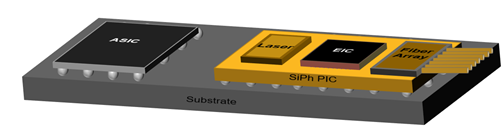
To support this complex, multidisciplinary design process, comprehensive multiphysics simulation tools and solutions enable verification, optimisation, and integration across the electrical, thermal, photonic, and structural domains.

  • Powerful capabilities enable integrity analysis, especially in the optical and high-speed domains, helping to ensure seamless data transmission through photonic interconnects.
  • For thermal and reliability management, advanced 3D thermal modelling tools enable detailed analysis. Additional solutions assist in analyzing thermal-induced stress and reliability risks at the chip and package level.
  • Optical–thermal integration allows true multiphysics co-simulation, bridging optical and thermal effects for a more accurate prediction of real-world behavior.
  • Optical design and simulation tools support the modeling and analysis of photonic integrated circuits (PICs) and optical I/O, enabling detailed design exploration of optical paths and interconnects.
  • Finally, circuit-level and system-level platforms facilitate the co-design of electronic and photonic integrated circuits, enabling system-level simulation and chip-to-chip coupling for complete end-to-end performance evaluation.

These tools empower engineers to confidently design, optimise, and validate co-packaged optics architectures, ensuring that performance, reliability, and thermal constraints are addressed early in the design cycle.

Share.
Exit mobile version