




Trending Insights
Why Software-Defined Vehicles Are Transforming Automotive Engineering, Ownership And Mobility Ecosystems Funding the Net-Zero Path: Carbon Capture Utilisation and Storage in Budget 2026 The Value-Centric Shift: How Global Manufacturing is Trading Optimization for Resilience Microscopy 4.0: Powering India’s Deep-Tech & Semiconductor Ambitions Alligator Automations Sets Up New PCMC Office in Pune to Strengthen Engineering and Operations Teams Fans Asked, Mahindra Listened: The BE 6 Batman Edition Returns Women Redefining Manufacturing Beckhoff Facilitates Physical AI Taking Automation to The Next Level With Natural Language NABL Accreditation Explained: What It Means forIndustrial Testing Labs in Bharat The End-to-End Process of Sheet-Metal Fabrication and Galvanising in Construction Supplies From Process Automation to Autonomous Coordination: Reimagining Manufacturing with Collaborative & Agentic AI Engineering Future-Ready Façade Solutions Through Innovation, Compliance & Sustainable Manufacturing Policy, Trade, and Incentives: A Roadmap for Sustaining Manufacturing Employment in India KPIT and IIT Bombay ink MOU to anchor cutting edge research and product development for next-gen mobility SiMa.ai and STIGA S.p.A. Announce Strategic Partnership in Physical AI The ePlane Company Unveils India’s Largest Integrated eVTOL Prototyping and Testing Facility at IIT Madras Discovery Campus University of Warwick’s study reveals Cleaner Solar Manufacturing Could Cut Global Emissions By 8.2 Billion Tonnes By 2035 Kaynes Semicon Announces Strategic Adoption of Synopsys Simulation Software Mitsubishi Electric India hosts 6th ME Cup, Sona College of Technology emerges winner among 35 selected teams Make in India, Hire in Bharat: Manufacturing’s Next Constraint Is Not Capital Precision Engineering Technologies and WFL Join Forces to Accelerate Complete Machining Adoption Across Indian Manufacturing Showcasing the Future of Smart Manufacturing at B&R Innovations Day 2026 Indian Army Successfully validate “Advance 28-ft Heavy Drop System – 20T (Type V)” Configuration Auto Component Manufacturing and the EV Shift: Policy, Investment and Innovation Priorities QVI India Opens New Office and Advanced Demo Centre in Bengaluru Ashok Leyland Plans Big Expansion in Western India WIDIA Turns 100: Defining and Celebrating a Century of Metal Cutting Solutions ACMA Automechanika New Delhi marks a major milestone, attracting 35,750 visitors alongside robust global participation from 870 exhibitors IMTEX FORMING 2026 Asia’s Largest Exhibition on Metal Forming and Manufacturing Technologies Records Consistent Growth in Size and Business Orders Tata Advanced Systems inaugurates helicopter production line for Airbus H125 helicopter to boost India’s vertical-lift capabilities Scaling CAE for High-Volume Manufacturing Environments Sona Comstar Integrating AI, Robotics and Electronics to Build a World-Class Mobility Technology Company: Priya Kapur at India-AI Impact Summit 2026 iCreate Drone Challenge Demo Day Showcases 14 Homegrown Startups Advancing India’s Indigenous Drone Technologies India AI Impact Summit 2026 Commences at Bharat Mandapam with Unprecedented Global Participation LMT Tools India Unveils Nation’s Largest Gear Cutting Tool Plant in Chakan BorgWarner to Supply Variable Turbine Geometry Turbocharger for Major European OEMs’ Hybrid Electric Vehicle Platform MIC Electronics Secures ₹4.45 Crore Orders from Eastern Railway ACMA–BCG Joint Study Highlights Smart Factories as a Key Enabler of India’s Auto Component Growth & Competitiveness CNH India Leads the Mechanization Movement with World-Class Crop Solutions Steelbird International Showcases Automotive Component Portfolio at ACMA Automechanika 2026 RODIM Launches R-Star Advanced Paint Protection Film at Automechanika 2026 Synopsys to Showcase AI-Driven Engineering Innovation at India AI Impact Summit 2026 Adhesive Dispensing in Automotive Body Shops: Driving Safety, Efficiency, and Durability MAHLE HeatX Range+ for More Range in Winter RIR Power Electronics Limited appoints N Ramesh Kumar as Managing Director and Chief Executive Officer Euler Motors and Jio-bp partner to accelerate EV charging infrastructure for commercial electric vehicles in India ACMA welcomes the India–US Trade Interim Agreement Framework Hindustan Zinc and Jawaharlal Nehru Centre for Advanced Scientific Research Advance Zinc-Ion Battery Technology for Large-Scale Energy Storage Cobots for Precision Manufacturing ACMA Automechanika New Delhi 2026 opens, spotlighting India’s global aftermarket ambitions Addverb Unveils Elixis-W, Its First Wheeled Humanoid, and Advanced Intralogistics Solutions at LogiMAT India 2026 How India Is Building Its Semiconductor Future Enabling India’s NextChapter in Sustainable, High-Performance Manufacturing Mahindra bags its biggest ever export order; 35,000 units of LCVs to be delivered to Agrinas Pangan Nusantara, Indonesia in 2026 Manufacturing the Future: Reforms, Technology, and the Road to Viksit Bharat 2047 Landmark US-India Trade Deal Eases Tariffs, Opens New Opportunities for Indian Industry SIAM Hosts 20th Styling & Design Conclave and 18th Automotive Design Challenge LSKB Aluminium Foils and JUPALCO Host Global Aluminium Foil Industry Leaders at Sonipat Facility During GLAFCO 2026 Budget 2026 Signals a Manufacturing-Led Growth Push Across Strategic Sectors Union Budget 2026: Manufacturing Industry Sets Its Expectations Customisable E-Rickshaws: The Rising Trend in Commercial Mobility Breaking the Bandwidth Barrier: How Co-Packaged Optics is Redefining High-Speed Connectivity Eastman IMPEX Showcased Advanced Formwork, Shoring and Scaffolding Solutions at World of Concrete 2026 Adani Defence & Aerospace and Embraer announce Strategic Partnership to Establish Regional Transport Aircraft Ecosystem in India Inovance India Expands Operations with New 50,000 sq. ft. Warehouse ACMA Welcomes the India–EU Free Trade Agreement From Local to Global: India’s Aftermarket and Auto component Industry Steps into the Global Fast Lane at ACMA Automechanika New Delhi IMTEX FORMING 2026 Showcased the Future of Metal Forming and Manufacturing New Greenfield Manufacturing Facility in India Strengthens Molding Solutions’ Global Strategy Swedish Clean-Tech Innovator KonveGas to Tackle India’s Energy Storage Bottleneck Neolite ZKW holds the Commemorative Ceremony of its Automotive Lighting Products Manufacturing Facility in Pune PARKSON sets a new benchmark in precision Precision at Scale: How Kennametal Is Powering the Future of Fastener Manufacturing From Compliance to Prevention: How Jarsh Safety Is Redefining Industrial Protection with Smart PPE Gulf Oil Lubricants Expands Infrastructure Portfolio with Key OEM Alliances Kennametal India to Showcase Tungsten Carbide Tooling Solutions for Fasteners Industry at Fastnex 2026 Juniper Green Energy Commissions Additional 72 MWp Solar Component of Hybrid Project in Solapur, Maharashtra ACMA Press Conference H1 FY26 TM Oil Lubrication Pump Advances Precision and Reliability in Centralised Lubrication Systems HGS Introduces AMLens: Accelerating AML Investigations with Explainable AI

India's Leading Magazine For Manufacturing Industries

Author – Yogesh Umbarkar, Vice President at Valtech APAC

As vehicles transition from distributed electronics to centralised computing platforms, software is becoming the defining element of automotive innovation, unlocking continuous upgrades, personalised features and entirely new business models.

The Next Revolution in Automotive Engineering

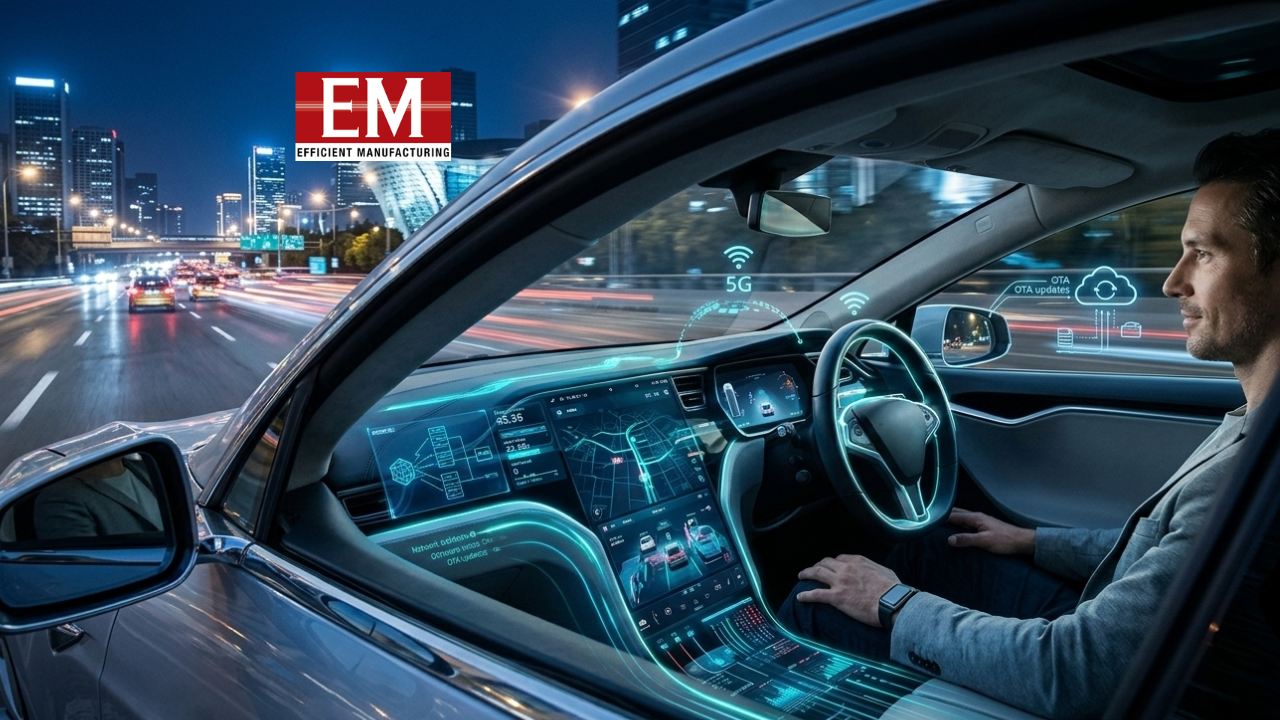
The automotive industry is undergoing a fundamental shift, from hardware-centric engineering to software-driven innovation. At the center of this transformation is the concept of the Software-Defined Vehicle (SDV), a new vehicle architecture where software controls, upgrades, and personalizes vehicle functionality throughout its lifecycle.

For decades, vehicles were primarily mechanical systems enhanced with electronics. Today, however, software is becoming the core element defining vehicle performance, features, and user experience.

From Distributed Systems to Centralized Intelligence

Traditional vehicles rely on a distributed electronic architecture consisting of multiple electronic control units (ECUs). Each system, such as braking, powertrain, body control, or suspension—has its own controller, sensors, and wiring. These controllers collect feedback from sensors, process it through a processor, and then instruct actuators to perform actions such as accelerating the vehicle or applying the brakes.

While effective, this architecture results in extensive wiring harnesses running throughout the vehicle. In some cases, the wiring can stretch several kilometers, adding complexity, weight, cost, and integration challenges.

To address these limitations, the automotive industry is gradually shifting toward zonal and centralized architectures. In this model, high-performance computing (HPC) systems replace multiple independent controllers, allowing different vehicle functions to be processed within a centralized computing platform.

With modern processors capable of handling significantly greater computational loads, a single computing unit can simultaneously manage multiple systems, including powertrain, body control, braking, and suspension; dramatically simplifying the vehicle’s electronic architecture.

Decoupling Software from Hardware

One of the key enablers of software-defined vehicles is the decoupling of software development from hardware development.

In traditional vehicle design, introducing new functionality often required hardware changes. This meant that software upgrades were tied to long development cycles, sometimes taking two to three years before a new feature could reach the market.

SDVs change this paradigm. Manufacturers can deploy vehicles with baseline software and introduce new capabilities later through updates—much like smartphones or personal computers.

Using Over-the-Air (OTA) and Firmware-Over-the-Air (FOTA) updates, automakers can remotely upgrade vehicle software, add features, fix bugs, or improve performance without requiring physical intervention.

This capability enables continuous improvement throughout the vehicle’s lifecycle and significantly shortens innovation cycles.

Unlocking Performance Through Software

Software-defined vehicles also introduce new ways of managing vehicle performance.

For instance, certain vehicle parameters, such as power output, may be deliberately limited within a predefined operational window for safety or efficiency reasons. However, because the hardware is capable of delivering higher performance, software updates can unlock additional capabilities when needed.

In practical terms, this means drivers could temporarily activate higher performance modes, for example, enabling additional horsepower for a specific journey, through software activation or subscription-based services.

This flexible performance model allows automakers to offer customizable vehicle experiences without altering the underlying hardware.

Personalization and the Rise of Subscription Models

The SDV ecosystem also enables a new level of hyper-personalization.

Just as smartphone users download only the applications they need, vehicle owners may choose from a range of software-enabled features, such as advanced driver assistance, enhanced performance modes, or digital cockpit functions, based on their preferences.

Instead of purchasing all features upfront, users may activate selected capabilities through subscription-based models, paying only for the features they use.

This approach opens up recurring revenue streams for automakers while offering customers more flexibility and customization.

Data-Driven Ecosystems

Software-defined vehicles also generate large volumes of operational data, enabling new ecosystem partnerships and business models.

Vehicle data can support services such as:

  • Usage-based insurance, where premiums are determined by driving behavior, distance traveled, or driving environments.
  • Predictive maintenance, where sensors monitor vehicle health and notify users when components such as brake pads or filters require replacement.
  • Location-based services, where the vehicle can interact with retail, mobility, or navigation platforms to offer personalized services.

For automakers, these data insights also provide valuable feedback about how vehicles perform in real-world conditions, enabling continuous product improvement.

Cybersecurity and Data Privacy Considerations

With greater connectivity and data generation, cybersecurity and data privacy have become critical considerations in SDV development.

Modern regulatory frameworks such as data protection laws require manufacturers to obtain user consent before using or sharing personal data. In addition, robust cybersecurity systems must be implemented to protect vehicles from unauthorized access or malicious attacks.

Ensuring secure data handling and transparent consent mechanisms will be essential for building consumer trust in connected and software-driven vehicles.

The Road Ahead

The transition to software-defined vehicles represents more than a technological upgrade, it marks a fundamental shift in how vehicles are designed, manufactured, and experienced.

By reducing hardware complexity, enabling continuous software upgrades, and creating new data-driven services, SDVs are redefining the automotive value chain. For manufacturers, this shift brings opportunities to innovate faster, optimize development costs, and establish new digital revenue streams.

For consumers, it promises vehicles that evolve over time, becoming smarter, more personalized, and more connected with every software update.

As the industry continues to embrace electrification, connectivity, and automation, software-defined vehicles are set to become the backbone of the next generation of mobility.

Share.
Exit mobile version