



Trending Insights
The Printer for The Smallest Details Fastener Fair India 2026 Opens Visitor Registration; Now at India Expo Mart, Greater Noida Mitsubishi Electric India Marks World Earth Day by Advancing Lake Conservation CSR with Community and Employee Participation in Talegaon India’s Packaging Industry Gears Up as PackPlus 2026 Opens Registrations for Visitors and Exhibitors MIC Electronics Strengthens RailTech Footprint with New Central Railway Mandate for Project Expansion Cleaner Production Standards: Raising the Bar for Industrial Fertilisers Vinfast Launches the All-New Vf MPV 7, A Spacious Electric Seven-Seater for Indian Customers Henkel announces new sustainability targets for 2030 East Coast Railway Awards ₹2.12 Crore Contract to MIC Electronics for Passenger Information System Upgrade IEEMA Launches The 17th Edition of ELECRAMA 2027, The World’s Largest Electrical Show Collaboration Over Competition: How Software and Machine Makers Are Building Connected Manufacturing Ecosystems SWITCH Mobility Completes India’s Largest Electric Bus Export to Mauritius PC-based control for grid stability and efficient energy management QNu Labs Validates Real-World Performance of ARMOS QKD in Independent Global Study with VIAVI Advancing India’s Die & Mould Industry with Mazak’s High-Performance Machining Solutions Emperium Group Leverages Advanced Construction Technologies to Launch ‘Emperium Titan’ on Dwarka Expressway, Gurugram Transforming Textile Workflows with Ergonomic Vacuum Technology InsideFPV Secures and Executes ₹10 Crore Ministry of Defence Contract In Two Months Under EPR for Kamikaze Drones From Knowing Chemistry to Owning Process: India’s Next Industrial Leap India’s Manufacturing Moment: Why Engineering and Component Makers Are Key to Global Competitiveness Solitaire Unveils PTK 362 Pro PTZ Camera  Powerplay Launches India’s First AI Workforce for Construction SiMa.ai Introduces Modalix PCIe HHHL Card, Purpose-Built to Support LLMs for Industrial PCs and Edge Server Physical AI Applications Robotic Material Handling: Transforming the Future of Industrial Operations Zenergize partners with Infineon Technologies to strengthen power-electronics solutions for India’s clean-energy ecosystem Waaree Energies Powers Up as The Main Principal Partner for Rajasthan Royals Eurobond Opens Delhi Flagship Experience Centre, Shifting Architectural Sourcing from Desk Catalogues to Immersive Retail Navigating the Perfect Storm: Challenges Plaguing the Auto Components Sector in 2026 OXMIQ Labs and AM Intelligence Labs Partner to Architect one of the world’s largest renewable-powered AI compute platforms BenQ Introduces RD280UG, a New Standard in Visual Comfort and Focus for Modern Developers Bengaluru Gets a World-Class Electronics Co-Innovation Hub as Henkel Launches Advanced Application Centre Ember Cookware Appoints Amit Singh as Chief of Supply Chain and Services MIC Electronics Achieves Pan-India Railway Milestone with ₹1.53 Crore Multi-Zone ELU Orders LG Electronics India Brings Comprehensive HVAC Ecosystem to ACREX 2026 – Spanning Residential Comfort to Industrial-Scale Cooling Bharat Forge and Liebherr-Aerospace Launch Advanced Landing Gear Machining Facility in Pune FAULHABER BXI: Made for the Next Generation of Robotics Schneider Electric launches ‘One Unit Mission’ to Accelerate India’s Energy Efficiency Movement Why Software-Defined Vehicles Are Transforming Automotive Engineering, Ownership And Mobility Ecosystems Funding the Net-Zero Path: Carbon Capture Utilisation and Storage in Budget 2026 The Value-Centric Shift: How Global Manufacturing is Trading Optimization for Resilience Microscopy 4.0: Powering India’s Deep-Tech & Semiconductor Ambitions Alligator Automations Sets Up New PCMC Office in Pune to Strengthen Engineering and Operations Teams Fans Asked, Mahindra Listened: The BE 6 Batman Edition Returns Women Redefining Manufacturing Beckhoff Facilitates Physical AI Taking Automation to The Next Level With Natural Language NABL Accreditation Explained: What It Means forIndustrial Testing Labs in Bharat The End-to-End Process of Sheet-Metal Fabrication and Galvanising in Construction Supplies From Process Automation to Autonomous Coordination: Reimagining Manufacturing with Collaborative & Agentic AI Engineering Future-Ready Façade Solutions Through Innovation, Compliance & Sustainable Manufacturing Policy, Trade, and Incentives: A Roadmap for Sustaining Manufacturing Employment in India KPIT and IIT Bombay ink MOU to anchor cutting edge research and product development for next-gen mobility SiMa.ai and STIGA S.p.A. Announce Strategic Partnership in Physical AI The ePlane Company Unveils India’s Largest Integrated eVTOL Prototyping and Testing Facility at IIT Madras Discovery Campus University of Warwick’s study reveals Cleaner Solar Manufacturing Could Cut Global Emissions By 8.2 Billion Tonnes By 2035 Kaynes Semicon Announces Strategic Adoption of Synopsys Simulation Software Mitsubishi Electric India hosts 6th ME Cup, Sona College of Technology emerges winner among 35 selected teams Make in India, Hire in Bharat: Manufacturing’s Next Constraint Is Not Capital Precision Engineering Technologies and WFL Join Forces to Accelerate Complete Machining Adoption Across Indian Manufacturing Showcasing the Future of Smart Manufacturing at B&R Innovations Day 2026 Indian Army Successfully validate “Advance 28-ft Heavy Drop System – 20T (Type V)” Configuration Auto Component Manufacturing and the EV Shift: Policy, Investment and Innovation Priorities QVI India Opens New Office and Advanced Demo Centre in Bengaluru Ashok Leyland Plans Big Expansion in Western India WIDIA Turns 100: Defining and Celebrating a Century of Metal Cutting Solutions ACMA Automechanika New Delhi marks a major milestone, attracting 35,750 visitors alongside robust global participation from 870 exhibitors IMTEX FORMING 2026 Asia’s Largest Exhibition on Metal Forming and Manufacturing Technologies Records Consistent Growth in Size and Business Orders Tata Advanced Systems inaugurates helicopter production line for Airbus H125 helicopter to boost India’s vertical-lift capabilities Scaling CAE for High-Volume Manufacturing Environments Sona Comstar Integrating AI, Robotics and Electronics to Build a World-Class Mobility Technology Company: Priya Kapur at India-AI Impact Summit 2026 iCreate Drone Challenge Demo Day Showcases 14 Homegrown Startups Advancing India’s Indigenous Drone Technologies India AI Impact Summit 2026 Commences at Bharat Mandapam with Unprecedented Global Participation LMT Tools India Unveils Nation’s Largest Gear Cutting Tool Plant in Chakan BorgWarner to Supply Variable Turbine Geometry Turbocharger for Major European OEMs’ Hybrid Electric Vehicle Platform MIC Electronics Secures ₹4.45 Crore Orders from Eastern Railway ACMA–BCG Joint Study Highlights Smart Factories as a Key Enabler of India’s Auto Component Growth & Competitiveness CNH India Leads the Mechanization Movement with World-Class Crop Solutions Steelbird International Showcases Automotive Component Portfolio at ACMA Automechanika 2026 RODIM Launches R-Star Advanced Paint Protection Film at Automechanika 2026 Synopsys to Showcase AI-Driven Engineering Innovation at India AI Impact Summit 2026 Adhesive Dispensing in Automotive Body Shops: Driving Safety, Efficiency, and Durability

India's Leading Magazine For Manufacturing Industries

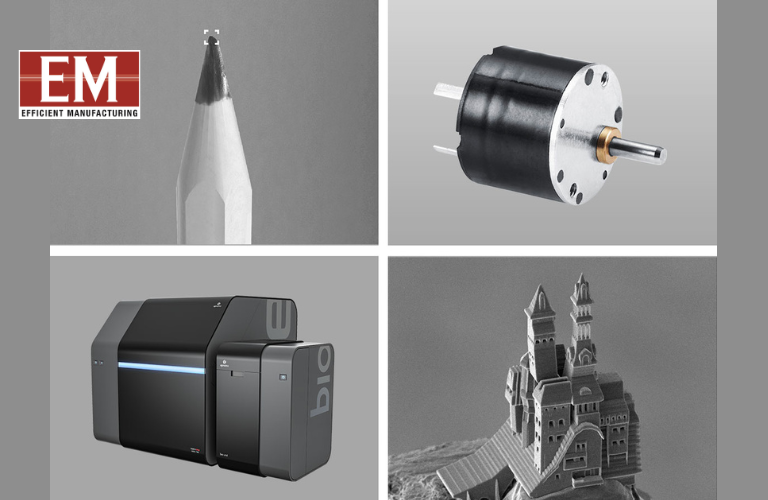
Miniature components from 3D printer.

Although the ancient Greek “nano” means “dwarf”, in the nano sector the dwarf would be a giant. In the technical realm, “nano” means ten to the power of negative nine, or one billionth. In addition, parts even smaller than this are possible, for example, the intricate shapes that come out of the NanoOne 3D printer from UpNano. To produce these, light particles are fired at the starting material. This is a process that plays out over a range of thousandths of a millimetre. So that the substrate can be precisely aligned here, three compact, high-performance motors from FAULHABER ensure the correct position.

The structures that UpNano produces in the 3D printer are so small that they are recognisable neither with the naked eye nor with a strong optical microscope. Only under a scanning electron microscope do the smallest printed structures become visible. They are a sort of “tiny sphere” or dust particle with a total diameter of just a fraction of a millimetre. The bars that make up the construct are 100 times thinner than a human hair. These structures are used, for example, in medical experiments as, among other things, a framework for living cells or as microfilters, microneedles or microlenses.

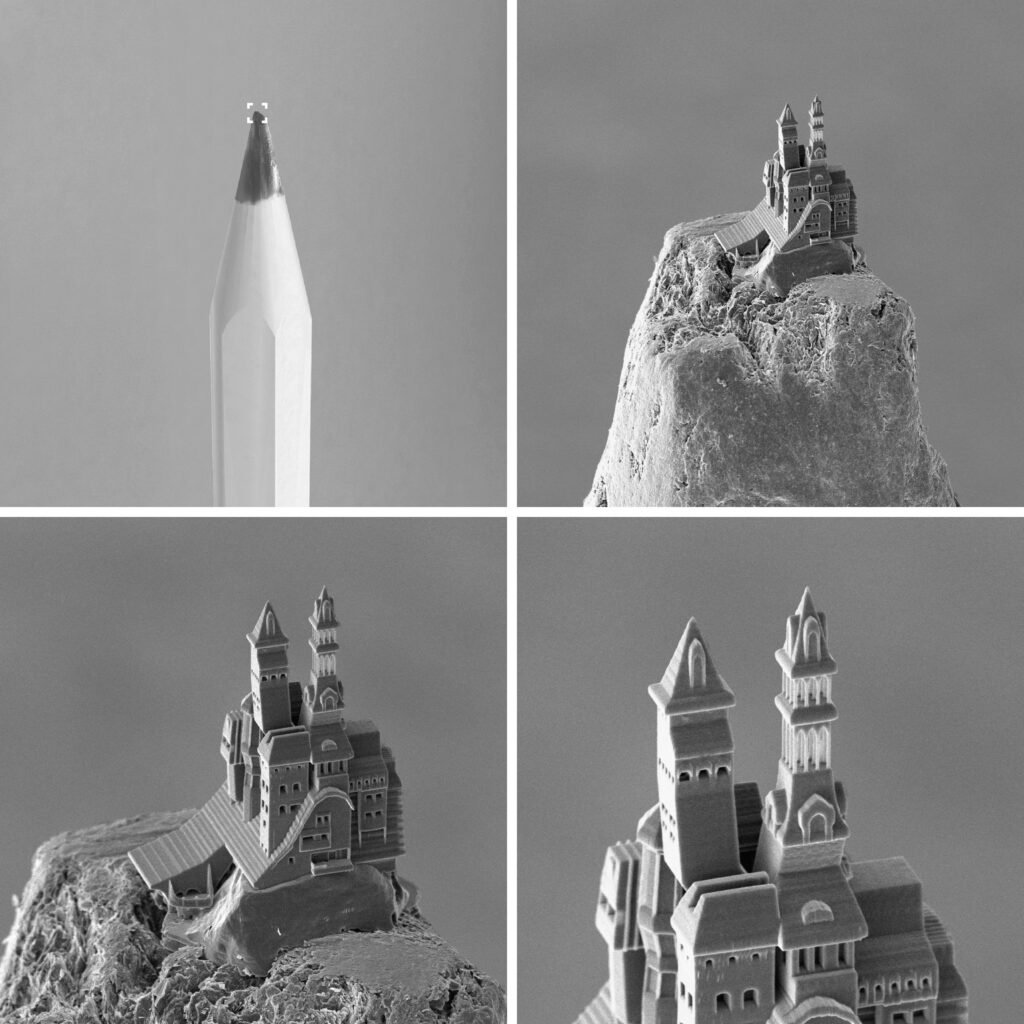
The castle, measuring just 6 millimetres in height on the tip of a pencil and printed on a NanoOne print system, impresses with extremely fine details. © UpNano GmbH

A castle on the tip of a pencil

UpNano is a spin-off of the Vienna University of Technology. Before the founders switched to free economy more than five years ago, they conducted research at the university in the field of 3D printing with high resolution. To demonstrate what is possible, they printed the model of a castle complete with multiple levels, oriels, ledges, archways, two spires and elegant columns – on the tip of a pencil. The columns were just 950

nanometres thick. The printer, which UpNano has since developed to market readiness and sells worldwide, goes even a step further: Structures smaller than 200 nanometres can be realised horizontally and smaller than 550 nanometres vertically.
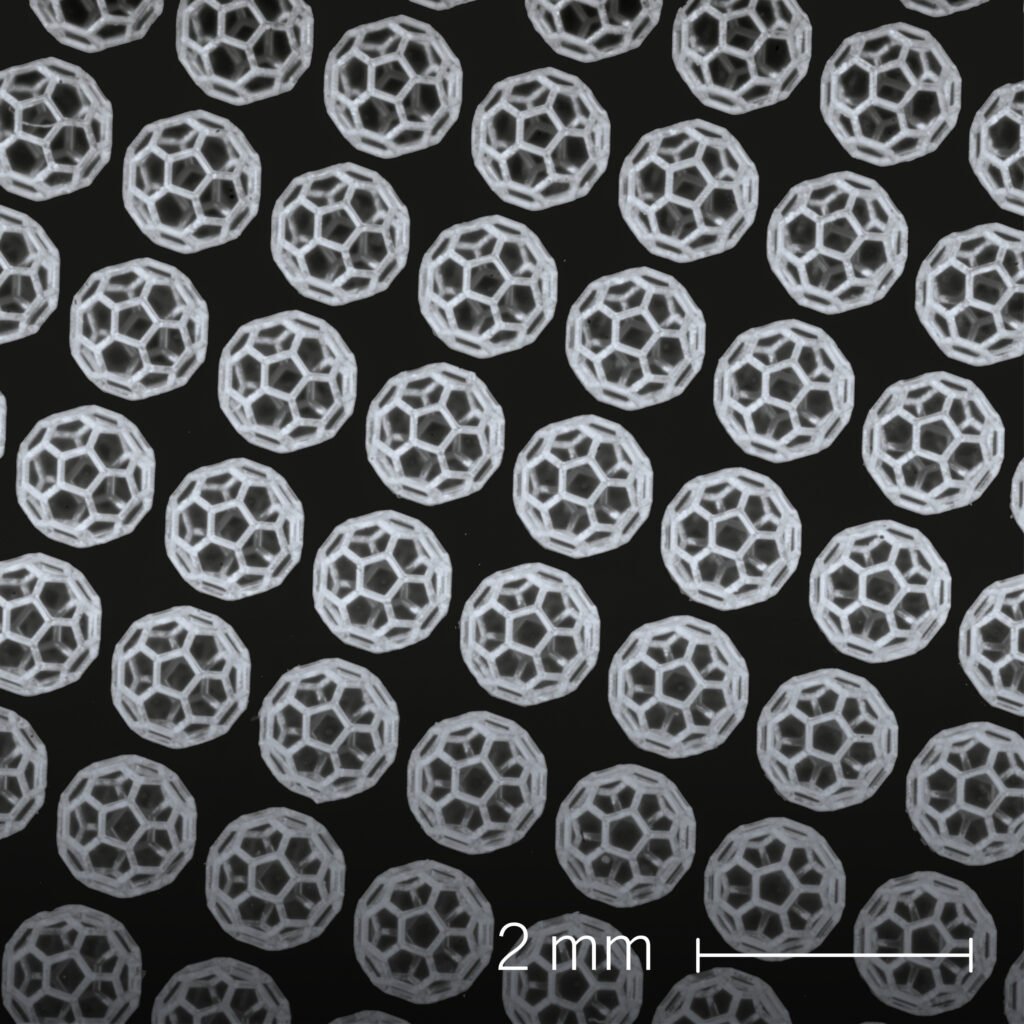
Scaffold structure for cell and tissue research, printed on a NanoOne print system.© UpNano GmbH

The production of such miniaturised objects is possible thanks to so-called 2-photon lithography, which is based on a quantum effect between two light particles. They thereby trigger the solidification of the material, resulting in the formation of stable chains in the plastic molecules. “To get the decisive photon pairs across the finish line, we need to fire a massive number of light particles,” explains Peter Gruber, co-founder and CTO of UpNano. “This is because we need an enormous photon density with respect to both time and space to bring about the controlled polymerisation.”

An accurate laser makes it possible

The laser that supplies the photons operates with extremely short, high-intensity pulses. Moreover, the method allows for high accuracy, as Peter Gruber explains: “With other light-based 3D-printing methods, polymerisation is triggered along the entire beam path. As a result, production can only be performed in layers. With 2-photon lithography, we can focus them on a tiny point. This point can be moved freely through the material by our printer’s high-performance optics. This allows us to produce nearly any geometric structure.”

In addition to channels and other elements for microfluidics, such structures can also be used to create lenses that are printed on the end of individual glass fibres. Printing can even take place in existing microfluidic chips to add additional structures there. A special additional module also enables printing with biomaterial, which contains living cells. Polymerisation of the three-dimensional structures transpires only at the intended locations; the cells in the spaces in between remain intact. The constructs can be formed like a cell cluster in human tissue. In such an arrangement, they are used today for pharmaceutical tests without animal experiments.

Micro-endoscopes and artificial insemination

The customers of UpNano are, however, generally reticent to answer the question of exactly what they are producing with the devices. Many use them under strict secrecy. “We are aware of only a few concrete applications, such as in in-vitro fertilisation, where work is performed with individual egg cells, or for lenses in micro-endoscopes,” reports Peter Gruber. “Our customers are mainly in medical technology, the pharmaceutical industry and telecommunication. There are also more and more industries that are discovering the possibilities of miniaturised 3D printing for their own uses.”

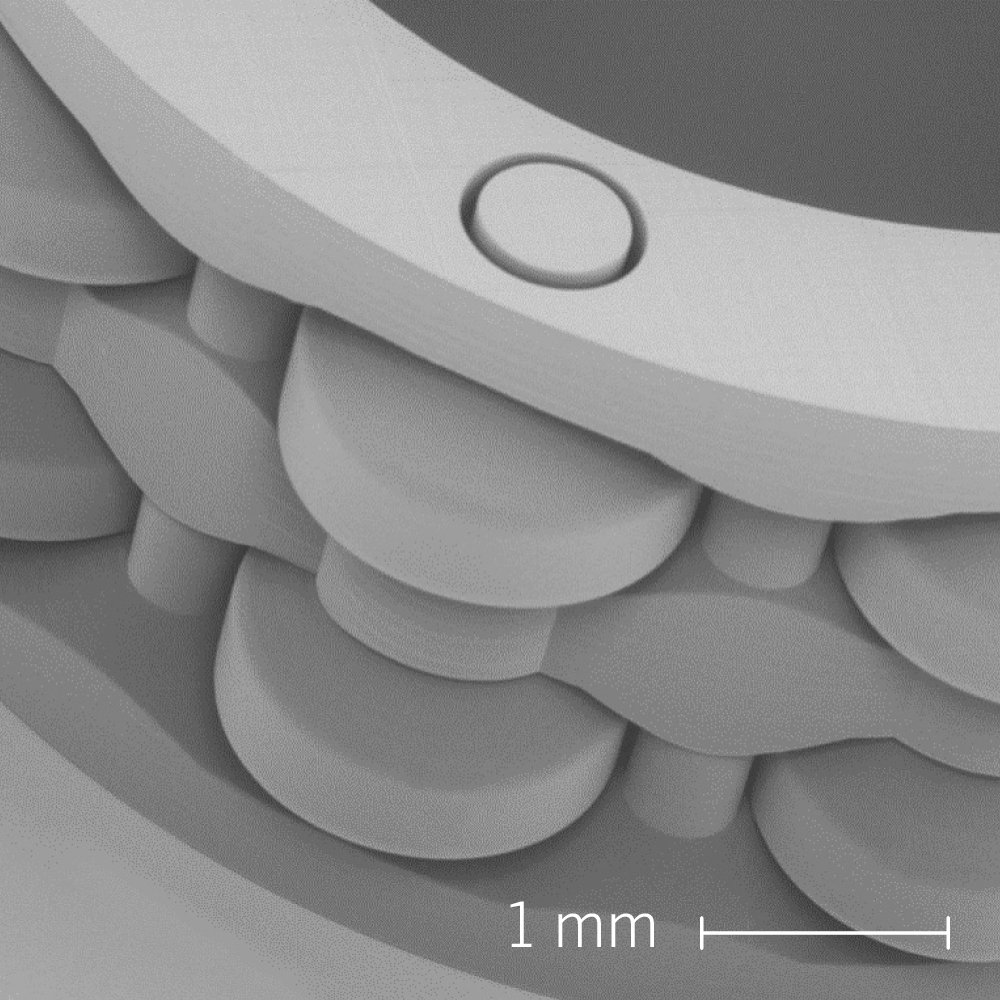
Fully functional, 3D-printed roller bearing, printed on a NanoOne print system. © UpNano GmbH
 

The size scale of the objects that can be produced with a Nano One printer spans from less than 150 nanometres to more than 40 millimetres. Four lenses with different resolutions ensure maximum flexibility. The throughput of more than 450 cubic millimetres per hour is the basis for high productivity. Precision of the printing process is ensured not only by the high-quality laser optics but also by the precise alignment of the substrate. This is secured on a moveable support.

FAULHABER drives in the NanoOne devices

The name “Automatic Tilt Correction Insert” describes the function of this support: It corrects the tipping that is nearly impossible to avoid when inserting the print substrate in the printer. The alignment of the substrate can be changed on three axes (x, y and z) and thereby optimally positioned. “We achieve a flatness in the sub-micrometre range,” emphasises Peter Gruber. “This ensures that the precision of the laser optics actually finds its way into the print material. Furthermore, the relevant components are decoupled from the surrounding technology and the housing. As a result, the printer can simply stand on any stable table.”

The mechanical force for the precise positioning of the support is supplied by three precious metal-commutated DC gear motors with an integrated encoder of the 1512 … SR IE2-8 series from Faulhaber. The uniquely flat winding technology with three flat, self-supporting copper windings enables an extremely compact design with a diameter of 15 millimetres and a length of just 14.3 millimetres. Thanks to the high-performance rare earth magnets, the motor delivers an especially high drive torque.

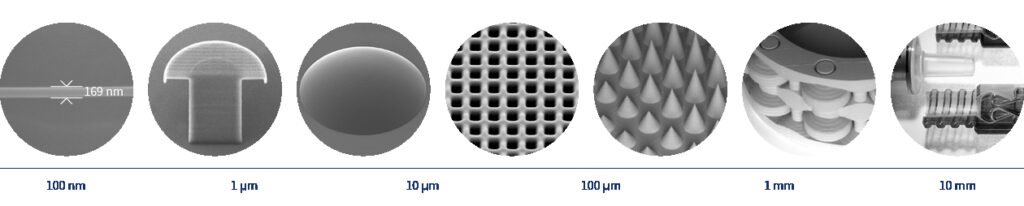
The NanoOne platform from UpNano enables the printing of sub-micrometer- to centimeter-sized structural details with a height of up to 40 millimeters © UpNano GmbH

In addition to the gearhead, an optical encoder is also integrated in the drive. “We selected the gearmotors as the optimum solution for our needs,” recalls Peter Gruber. “The suggestion to select the version with an encoder came from FAULHABER. Alignment thereby functions even more precisely and more smoothly. In relation to its small dimensions, the drive delivers enormous power. With its high precision, it contributes to the quality of the printing process of our NanoOne devices at a key point.”

Share.
Exit mobile version