


Trending Insights
Waaree Energies Powers Up as The Main Principal Partner for Rajasthan Royals Eurobond Opens Delhi Flagship Experience Centre, Shifting Architectural Sourcing from Desk Catalogues to Immersive Retail Navigating the Perfect Storm: Challenges Plaguing the Auto Components Sector in 2026 OXMIQ Labs and AM Intelligence Labs Partner to Architect one of the world’s largest renewable-powered AI compute platforms BenQ Introduces RD280UG, a New Standard in Visual Comfort and Focus for Modern Developers Bengaluru Gets a World-Class Electronics Co-Innovation Hub as Henkel Launches Advanced Application Centre Ember Cookware Appoints Amit Singh as Chief of Supply Chain and Services MIC Electronics Achieves Pan-India Railway Milestone with ₹1.53 Crore Multi-Zone ELU Orders LG Electronics India Brings Comprehensive HVAC Ecosystem to ACREX 2026 – Spanning Residential Comfort to Industrial-Scale Cooling Bharat Forge and Liebherr-Aerospace Launch Advanced Landing Gear Machining Facility in Pune FAULHABER BXI: Made for the Next Generation of Robotics Schneider Electric launches ‘One Unit Mission’ to Accelerate India’s Energy Efficiency Movement Why Software-Defined Vehicles Are Transforming Automotive Engineering, Ownership And Mobility Ecosystems Funding the Net-Zero Path: Carbon Capture Utilisation and Storage in Budget 2026 The Value-Centric Shift: How Global Manufacturing is Trading Optimization for Resilience Microscopy 4.0: Powering India’s Deep-Tech & Semiconductor Ambitions Alligator Automations Sets Up New PCMC Office in Pune to Strengthen Engineering and Operations Teams Fans Asked, Mahindra Listened: The BE 6 Batman Edition Returns Women Redefining Manufacturing Beckhoff Facilitates Physical AI Taking Automation to The Next Level With Natural Language NABL Accreditation Explained: What It Means forIndustrial Testing Labs in Bharat The End-to-End Process of Sheet-Metal Fabrication and Galvanising in Construction Supplies From Process Automation to Autonomous Coordination: Reimagining Manufacturing with Collaborative & Agentic AI Engineering Future-Ready Façade Solutions Through Innovation, Compliance & Sustainable Manufacturing Policy, Trade, and Incentives: A Roadmap for Sustaining Manufacturing Employment in India KPIT and IIT Bombay ink MOU to anchor cutting edge research and product development for next-gen mobility SiMa.ai and STIGA S.p.A. Announce Strategic Partnership in Physical AI The ePlane Company Unveils India’s Largest Integrated eVTOL Prototyping and Testing Facility at IIT Madras Discovery Campus University of Warwick’s study reveals Cleaner Solar Manufacturing Could Cut Global Emissions By 8.2 Billion Tonnes By 2035 Kaynes Semicon Announces Strategic Adoption of Synopsys Simulation Software Mitsubishi Electric India hosts 6th ME Cup, Sona College of Technology emerges winner among 35 selected teams Make in India, Hire in Bharat: Manufacturing’s Next Constraint Is Not Capital Precision Engineering Technologies and WFL Join Forces to Accelerate Complete Machining Adoption Across Indian Manufacturing Showcasing the Future of Smart Manufacturing at B&R Innovations Day 2026 Indian Army Successfully validate “Advance 28-ft Heavy Drop System – 20T (Type V)” Configuration Auto Component Manufacturing and the EV Shift: Policy, Investment and Innovation Priorities QVI India Opens New Office and Advanced Demo Centre in Bengaluru Ashok Leyland Plans Big Expansion in Western India WIDIA Turns 100: Defining and Celebrating a Century of Metal Cutting Solutions ACMA Automechanika New Delhi marks a major milestone, attracting 35,750 visitors alongside robust global participation from 870 exhibitors IMTEX FORMING 2026 Asia’s Largest Exhibition on Metal Forming and Manufacturing Technologies Records Consistent Growth in Size and Business Orders Tata Advanced Systems inaugurates helicopter production line for Airbus H125 helicopter to boost India’s vertical-lift capabilities Scaling CAE for High-Volume Manufacturing Environments Sona Comstar Integrating AI, Robotics and Electronics to Build a World-Class Mobility Technology Company: Priya Kapur at India-AI Impact Summit 2026 iCreate Drone Challenge Demo Day Showcases 14 Homegrown Startups Advancing India’s Indigenous Drone Technologies India AI Impact Summit 2026 Commences at Bharat Mandapam with Unprecedented Global Participation LMT Tools India Unveils Nation’s Largest Gear Cutting Tool Plant in Chakan BorgWarner to Supply Variable Turbine Geometry Turbocharger for Major European OEMs’ Hybrid Electric Vehicle Platform MIC Electronics Secures ₹4.45 Crore Orders from Eastern Railway ACMA–BCG Joint Study Highlights Smart Factories as a Key Enabler of India’s Auto Component Growth & Competitiveness CNH India Leads the Mechanization Movement with World-Class Crop Solutions Steelbird International Showcases Automotive Component Portfolio at ACMA Automechanika 2026 RODIM Launches R-Star Advanced Paint Protection Film at Automechanika 2026 Synopsys to Showcase AI-Driven Engineering Innovation at India AI Impact Summit 2026 Adhesive Dispensing in Automotive Body Shops: Driving Safety, Efficiency, and Durability MAHLE HeatX Range+ for More Range in Winter RIR Power Electronics Limited appoints N Ramesh Kumar as Managing Director and Chief Executive Officer Euler Motors and Jio-bp partner to accelerate EV charging infrastructure for commercial electric vehicles in India ACMA welcomes the India–US Trade Interim Agreement Framework Hindustan Zinc and Jawaharlal Nehru Centre for Advanced Scientific Research Advance Zinc-Ion Battery Technology for Large-Scale Energy Storage Cobots for Precision Manufacturing ACMA Automechanika New Delhi 2026 opens, spotlighting India’s global aftermarket ambitions Addverb Unveils Elixis-W, Its First Wheeled Humanoid, and Advanced Intralogistics Solutions at LogiMAT India 2026 How India Is Building Its Semiconductor Future Enabling India’s NextChapter in Sustainable, High-Performance Manufacturing Mahindra bags its biggest ever export order; 35,000 units of LCVs to be delivered to Agrinas Pangan Nusantara, Indonesia in 2026 Manufacturing the Future: Reforms, Technology, and the Road to Viksit Bharat 2047 Landmark US-India Trade Deal Eases Tariffs, Opens New Opportunities for Indian Industry SIAM Hosts 20th Styling & Design Conclave and 18th Automotive Design Challenge LSKB Aluminium Foils and JUPALCO Host Global Aluminium Foil Industry Leaders at Sonipat Facility During GLAFCO 2026 Budget 2026 Signals a Manufacturing-Led Growth Push Across Strategic Sectors Union Budget 2026: Manufacturing Industry Sets Its Expectations Customisable E-Rickshaws: The Rising Trend in Commercial Mobility Breaking the Bandwidth Barrier: How Co-Packaged Optics is Redefining High-Speed Connectivity Eastman IMPEX Showcased Advanced Formwork, Shoring and Scaffolding Solutions at World of Concrete 2026 Adani Defence & Aerospace and Embraer announce Strategic Partnership to Establish Regional Transport Aircraft Ecosystem in India Inovance India Expands Operations with New 50,000 sq. ft. Warehouse ACMA Welcomes the India–EU Free Trade Agreement From Local to Global: India’s Aftermarket and Auto component Industry Steps into the Global Fast Lane at ACMA Automechanika New Delhi IMTEX FORMING 2026 Showcased the Future of Metal Forming and Manufacturing

India's Leading Magazine For Manufacturing Industries

| Step into the fascinating world of textile machinery, where innovation meets tradition to craft the fabrics that shape our lives. This article explores the intricate processes and cutting-edge technologies that have revolutionised textile production, ushering in a new era of efficiency and quality. 

Dr Poonam Bhagchandani, Associate Professor, Art & Design, SSDAP, Sharda University

Shivani Chandra, Assistant Professor, Art & Design, SSDAP, Sharda University

New industrial procedures were introduced during the Industrial Revolution, which lasted from the 1760s through some point between 1820 and 1840. As a result of this transformation, new chemical manufacturing processes, automated production methods and iron production were implemented. The Industrial Revolution was primarily driven by the textile industry. The textile business uses varied machines to stitch fabrics and create clothing, carpets and other textile products. These sewing machines, which range in size from enormous heavyduty industrial machines to tiny consumer-sized machines, are employed by individuals for their projects, in factories and only by insignificant textile manufacturers.

Machines involving fibre/yarn/thread production 

• Thread winding machines: The fundamental purpose of winding is to move the yarn from one appropriate container to another. Winding is also required for packing, clearing and checking the yarn to enhance quality and eliminate flaws. The purpose of these devices is to wind thread onto spools. 

Shivani Chandra,

• Spinning machines: Before a thread can be stitched together, it must first be created through the process of spinning. These spinning machines are used to spin materials like cotton into a thread or yarn. The thread or yarn can be knitted or woven together to make a piece of cloth. 

• Carding machines: Since carding performs all of the primary duties, it is sometimes referred to as the beating heart of spinning. The dust and grime are removed here after the fibres have been opened up to more or less single strands. 

• Bleaching/dyeing machines: One of the most crucial components in the textile business is dyeing. Different forms of cloth colouring are carried out in the dyeing area according to the buyer’s demands and specifications. To provide an even shade with a fastness suited and performance to its end usage, the dyeing procedure is utilised. In contrast, bleaching is used to take out pigments and natural colours that are present in the. It is a chemical process used to remove the substrate’s natural coloration, which can be used on yarn, knitted fabric and woven fabrics.

Textile machinery Some of the major machines that are used in textile manufacturing are:

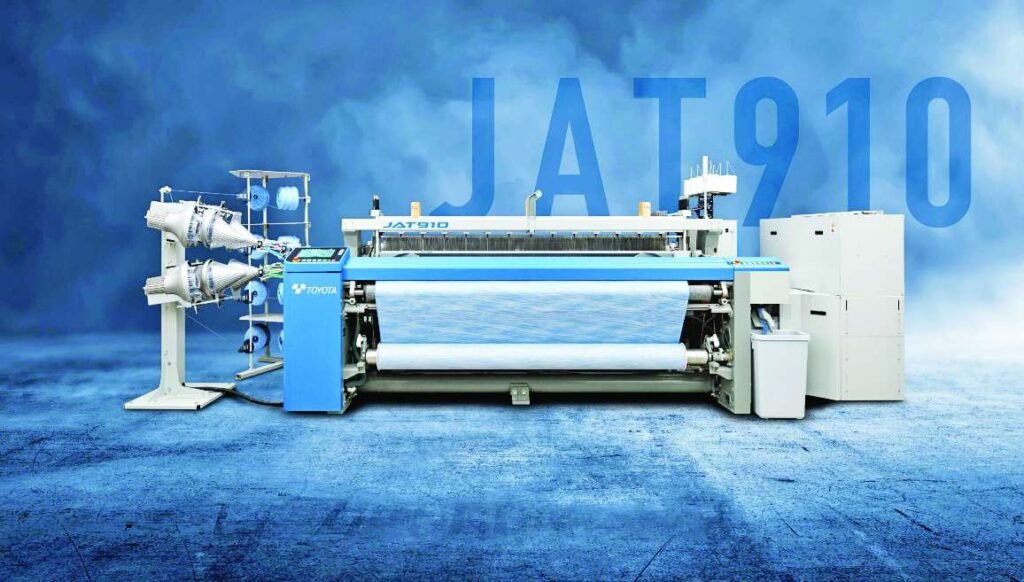
• Air jet loom machines: Air jet weaving machines are one type of contemporary weaving equipment with the highest weft insertion performance and are thought to be the most productive in the production of light to medium-weight fabrics, preferably made of cotton and certain synthetic fibres (sheets, shirting fabrics, linings, taffetas and satins in staple yarns of synthetic fibres); it must be noted, however, that technically positive results are currently also obtained with heavy weight fabrics (denim, leather etc.). For individuals who wish to make large numbers of bespoke fabric styles, these machines are the best option. Generally speaking, the weaving widths range from 190 to 400 cm. There are up to eight distinct colours on the multi-colour weft carrier. The JAT910 AIR JET LOOM (Fig 1) by Toyota has embraced the goal to continue growing with its consumers while understanding their changing demands. 

• Air jet spinning machines: Contra-rotating twin jets are used in Murata’s Vortex Jet Spinning (MJS) to improve the wrapping of edge fibres. The research has demonstrated that the cross-sectional number of fibres affects jet spinning. Given that the number of wrapper fibres is capped by the number of edge fibres on the surface and that the strength is directly correlated with the wrapper fibres. When the yarn’s fibre count rises, the proportion of wrapper fibres decreases and the tenacity drops. Additionally, the wrapping length decreases with increasing count coarseness, which lowers tenacity. As a result, two difficulties required attention: a greater quantity of wrapper fibres and a longer extent of wrapper fibres. The Murata Vortex Spinning (MVS) technology resolves some of the problems with prior iterations of air-jet spinning systems by using more than two air jets to form a 3D air vortex. By producing more edge fibres, switching from a 2D to a 3D system enables a considerable increase in the number of wrapper fibres.

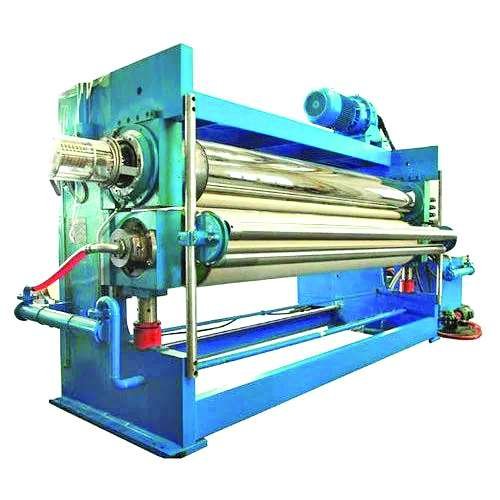
• Fabric finishing machine The Automatic Textile Calendaring Machine (Fig 2) has attached rollers that guarantee crease-free travel. The machine’s top advantages include trouble-free operation, smooth performance and low maintenance requirements. They have designed models specifically to meet the needs of the textile industry, providing dimensional stability to all types of materials. As implied by the name, calendaring is the process of treating cotton with a strong caustic alkaline solution to enhance its shine, stability, tensile strength, water sorption and other qualities. For all wholesale orders, this machine is provided to the clients at prices that are at the top of the market.

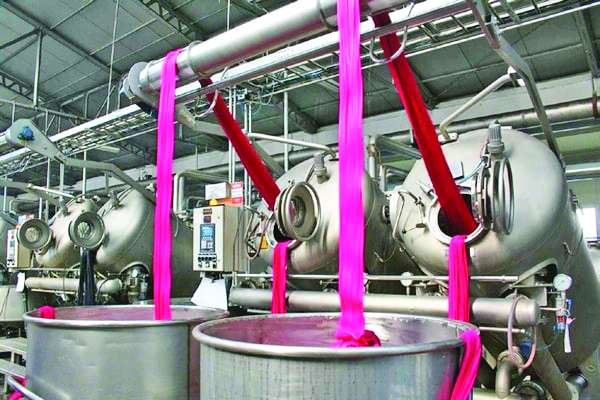
• Jet dyeing machine India’s Surat-based Apex Engineers (Fig 3), the most advanced machine for dispersing colouring polyester fabric is the jet dyeing machine. These machines allow for a speedier and more consistent dying process because the cloth and dye fluid are both in motion. There is no fabric driving reel to move the cloth in a jet dyeing machine. The force of the water helps the cloth move. It is affordable because of the low alcohol percentage. In contrast to a long tube dyeing machine, only four valves are needed to regulate the movement of the cloth, making it more user-friendly. There is only one valve in jet dyeing equipment and fabric dyeing machines.

Conclusion 

These are some of the highly automated, effective machines that are now utilised in the textile manufacturing sectors and that will also alter the course of production in the future. The textile industry is not only evolving but also revolutionising itself. It is on the cusp of a new era, promising textiles that are not just functional but also environmentally conscious. With each advancement, the fabric of our future becomes brighter and more technologically advanced than ever before. 

Share.
Exit mobile version