


Trending Insights
Budget 2026 Signals a Manufacturing-Led Growth Push Across Strategic Sectors Union Budget 2026: Manufacturing Industry Sets Its Expectations Customisable E-Rickshaws: The Rising Trend in Commercial Mobility Breaking the Bandwidth Barrier: How Co-Packaged Optics is Redefining High-Speed Connectivity Eastman IMPEX Showcased Advanced Formwork, Shoring and Scaffolding Solutions at World of Concrete 2026 Adani Defence & Aerospace and Embraer announce Strategic Partnership to Establish Regional Transport Aircraft Ecosystem in India Inovance India Expands Operations with New 50,000 sq. ft. Warehouse ACMA Welcomes the India–EU Free Trade Agreement From Local to Global: India’s Aftermarket and Auto component Industry Steps into the Global Fast Lane at ACMA Automechanika New Delhi IMTEX FORMING 2026 Showcased the Future of Metal Forming and Manufacturing New Greenfield Manufacturing Facility in India Strengthens Molding Solutions’ Global Strategy Swedish Clean-Tech Innovator KonveGas to Tackle India’s Energy Storage Bottleneck Neolite ZKW holds the Commemorative Ceremony of its Automotive Lighting Products Manufacturing Facility in Pune PARKSON sets a new benchmark in precision Precision at Scale: How Kennametal Is Powering the Future of Fastener Manufacturing From Compliance to Prevention: How Jarsh Safety Is Redefining Industrial Protection with Smart PPE Gulf Oil Lubricants Expands Infrastructure Portfolio with Key OEM Alliances Kennametal India to Showcase Tungsten Carbide Tooling Solutions for Fasteners Industry at Fastnex 2026 Juniper Green Energy Commissions Additional 72 MWp Solar Component of Hybrid Project in Solapur, Maharashtra ACMA Press Conference H1 FY26 TM Oil Lubrication Pump Advances Precision and Reliability in Centralised Lubrication Systems HGS Introduces AMLens: Accelerating AML Investigations with Explainable AI ACMA Automechanika New Delhi 2026 set to host its Largest Edition with 800+ Exhibitors from 19 countries Brandworks Technologies announces its foray into Automotive, EV Electronics Space at CES 2026 HONEYWELL MODULAR COIL WOUND HEAT EXCHANGER TECHNOLOGY TO ACCELERATE PRODUCTION AT COMMONWEALTH LNG FACILITY Avro India Leads Waste-to-Wealth Shift with India’s Largest Flexible Plastic Recycling Unit MATTER and Niron Magnetics set a new benchmark in EV Innovation, Reveal the First-of-Its-Kind Rare-Earth-Free Variable Flux Motor Building Trust in Industrial Data: The Foundation for Responsible AI Adoption in Manufacturing ideazmeet Launches dotsupply to Support Global Supply Chain Diversification How Precision Sensors Facilitate Intelligent Lubrication for Industrial Machines Beyond Energy Efficiency: Air-Saving Ejectors Drive Sustainability and Reduce Global Warming in Industry Strategic Capital, Strong Foundations: ELV Projects’ Growth Roadmap with Institutional Backing India’s AI Moment: Why Copyright could make or break innovation RSB Group pledges to achieve 50% renewable energy adoption and 45% Emissions Cut by 2030 BenQ Launches BSH and BDH Monitor Arms: Premium Ergonomic Workspace Solutions Built by Trusted Monitor Experts Eastman Impex Strengthens Global Outreach at MITEX 2025 in Moscow QAD | Redzone Marks 20 Years in India and Unveils the Next Era of Intelligent Manufacturing at Champions of Manufacturing India 2025 SquadStack.ai Launches In-App Voice AI Assistant to Reimagine Digital Customer Journeys AI in Manufacturing: How Predictive Tech Is Redefining Quality and Cost in Consumer Durables Kirloskar Group Unveils ‘Made in Kirloskar’ Initiative, Celebrating Engineers, Engineering and the Spirit of Making EMCO Mecof MEGAMILL: the giant milling machine that combines power, precision and connectivity Rohit Markan Appointed Executive Vice President AsiaPacific For Continental’s Industrial Solutions Business The World’s Leading Industrial Fair, HANNOVER MESSE, Returns Reinvented for 2026 Cummins India Showcases its Next-Generation Power Portfolio for Infrastructure and Construction at EXCON 2025 Tata Motors leads the way with innovative, sustainable and intelligent mobility solutions at EXCON 2025 Mahindra unveils its New Mini Compactor, ‘COMPAX’ for Road Construction Industry with cutting-edge Technology Building the Future of Mobility: India’s EV Progress Through Hybrid Manufacturing and System Integration EUROBOND launches EURODUAL, becomes one of the first Indian Brands to produce Engineered Solid Panels Uno Minda Takes Full Control of EV Components JV, Announces ₹40 Crore Investment Kinetiq Rrobotics Concludes a Successful Showcase at Clean India Show 2025 — A Strong Market Debut Backed by Star Engineers’ 37-Year Legacy VIAVI and QNu Labs Partner to Accelerate Quantum-Safe Network Security Toyota Kirloskar Motor Signs MoU with Government of Nagaland to Implement Strategic CSR Initiatives Knauf India Doubles Production Capacity at Khushkhera Plant, Strengthens Manufacturing Footprint Mitsubishi Electric India to Showcase Breakthrough Power Semiconductor Technologies at PCIM India 2025 Kennametal to Showcase Advanced Earth Cutting Tools and Wear Protection Solutions at EXCON 2025 in Bengaluru Alligator Automations Unveils Its ₹40-Crore State-of-the-Art Plant to Boost Capacity and International Reach Jyoti Global Plast Unveils AeroCrop Agricultural UAS Mphasis’ Sparkle Innovation Program joins forces with Startups to accelerate next-gen innovation for clients Finolex Industries announces leadership changes, Poised for continued growth ANAND Group Appoints Mohua Mandal as Senior GM & Head of Group Communications SCG Partners with Rondo Energy To Launch ‘Southeast Asia’s First Industrial Heat Battery’, Unlocking 24-Hour Clean Energy Storage for Industry JSW Defence Commences Construction of Next-Gen UAS Facility in Hyderabad MAHLE and Jumana Al-Sibai part ways The Coolest Partnership Ever: Panasonic Brings “Captain Cool” MS Dhoni on board Saatvik Green Energy Limited achieves prestigious CII-IGBC Green Factory Building silver rating for its Ambala manufacturing facility EMO – the world’s leading trade fair for production technology to remain in Hanover How AI-Powered, Secure-by-Default Systems Can Drive Scalable Growth in Industry 4.0 Bridgestone India Expands Retail Footprint in Punjab with New Select Store in Firozpur Ultraviolette Expands To Six Locations Across Mumbai and Pune, Within 48 Hours Fronius presents the Velocity Assistant for manual MIG/MAG welding Engineering Hardware to be India’s Next Billion-Dollar Opportunity, says Hardware Industry Startup Ecosystem Report by CII, KPMG, and Synopsys HMS Networks launches new N-Tron® unmanaged industrial Ethernet switches to support mission-critical operations in rugged environments YugX Announces Strategic Partnership with MP Lifts Honeywell to help Dangote double production capabilities at Africa’s largest refinery Eastman Showcases Indian Engineering Excellence at the 138th Canton Fair Euler Motors rolls out‘Euler Prime’,a preemptive on-the-spot support solution for customers in 45+ cities BASF inaugurates the expansion of production capacity for Alkyl Polyglucosides (APGs) in Bangpakong, Thailand SKF India Strengthens Automotive Marketing Leadership Stability meets versatility – for all materials and grooving applications Success in China: Evermore Counts on Cylindrical Grinding Machines From STUDER

India's Leading Magazine For Manufacturing Industries

| Step into the fascinating world of textile machinery, where innovation meets tradition to craft the fabrics that shape our lives. This article explores the intricate processes and cutting-edge technologies that have revolutionised textile production, ushering in a new era of efficiency and quality. 

Dr Poonam Bhagchandani, Associate Professor, Art & Design, SSDAP, Sharda University

Shivani Chandra, Assistant Professor, Art & Design, SSDAP, Sharda University

New industrial procedures were introduced during the Industrial Revolution, which lasted from the 1760s through some point between 1820 and 1840. As a result of this transformation, new chemical manufacturing processes, automated production methods and iron production were implemented. The Industrial Revolution was primarily driven by the textile industry. The textile business uses varied machines to stitch fabrics and create clothing, carpets and other textile products. These sewing machines, which range in size from enormous heavyduty industrial machines to tiny consumer-sized machines, are employed by individuals for their projects, in factories and only by insignificant textile manufacturers.

Machines involving fibre/yarn/thread production 

• Thread winding machines: The fundamental purpose of winding is to move the yarn from one appropriate container to another. Winding is also required for packing, clearing and checking the yarn to enhance quality and eliminate flaws. The purpose of these devices is to wind thread onto spools. 

Shivani Chandra,

• Spinning machines: Before a thread can be stitched together, it must first be created through the process of spinning. These spinning machines are used to spin materials like cotton into a thread or yarn. The thread or yarn can be knitted or woven together to make a piece of cloth. 

• Carding machines: Since carding performs all of the primary duties, it is sometimes referred to as the beating heart of spinning. The dust and grime are removed here after the fibres have been opened up to more or less single strands. 

• Bleaching/dyeing machines: One of the most crucial components in the textile business is dyeing. Different forms of cloth colouring are carried out in the dyeing area according to the buyer’s demands and specifications. To provide an even shade with a fastness suited and performance to its end usage, the dyeing procedure is utilised. In contrast, bleaching is used to take out pigments and natural colours that are present in the. It is a chemical process used to remove the substrate’s natural coloration, which can be used on yarn, knitted fabric and woven fabrics.

Textile machinery Some of the major machines that are used in textile manufacturing are:

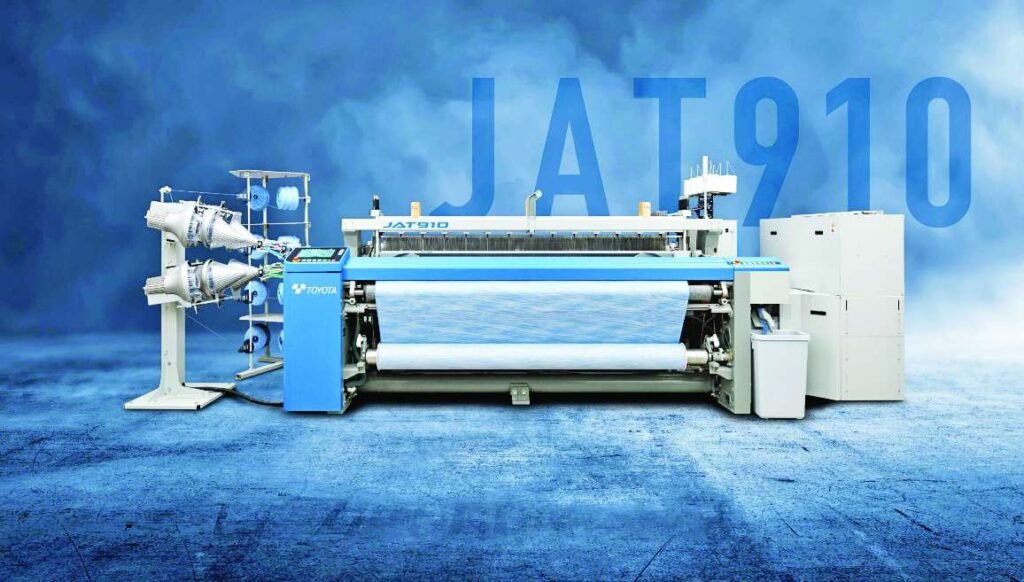
• Air jet loom machines: Air jet weaving machines are one type of contemporary weaving equipment with the highest weft insertion performance and are thought to be the most productive in the production of light to medium-weight fabrics, preferably made of cotton and certain synthetic fibres (sheets, shirting fabrics, linings, taffetas and satins in staple yarns of synthetic fibres); it must be noted, however, that technically positive results are currently also obtained with heavy weight fabrics (denim, leather etc.). For individuals who wish to make large numbers of bespoke fabric styles, these machines are the best option. Generally speaking, the weaving widths range from 190 to 400 cm. There are up to eight distinct colours on the multi-colour weft carrier. The JAT910 AIR JET LOOM (Fig 1) by Toyota has embraced the goal to continue growing with its consumers while understanding their changing demands. 

• Air jet spinning machines: Contra-rotating twin jets are used in Murata’s Vortex Jet Spinning (MJS) to improve the wrapping of edge fibres. The research has demonstrated that the cross-sectional number of fibres affects jet spinning. Given that the number of wrapper fibres is capped by the number of edge fibres on the surface and that the strength is directly correlated with the wrapper fibres. When the yarn’s fibre count rises, the proportion of wrapper fibres decreases and the tenacity drops. Additionally, the wrapping length decreases with increasing count coarseness, which lowers tenacity. As a result, two difficulties required attention: a greater quantity of wrapper fibres and a longer extent of wrapper fibres. The Murata Vortex Spinning (MVS) technology resolves some of the problems with prior iterations of air-jet spinning systems by using more than two air jets to form a 3D air vortex. By producing more edge fibres, switching from a 2D to a 3D system enables a considerable increase in the number of wrapper fibres.

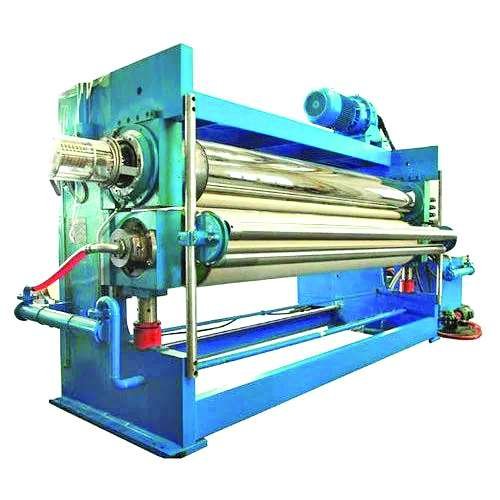
• Fabric finishing machine The Automatic Textile Calendaring Machine (Fig 2) has attached rollers that guarantee crease-free travel. The machine’s top advantages include trouble-free operation, smooth performance and low maintenance requirements. They have designed models specifically to meet the needs of the textile industry, providing dimensional stability to all types of materials. As implied by the name, calendaring is the process of treating cotton with a strong caustic alkaline solution to enhance its shine, stability, tensile strength, water sorption and other qualities. For all wholesale orders, this machine is provided to the clients at prices that are at the top of the market.

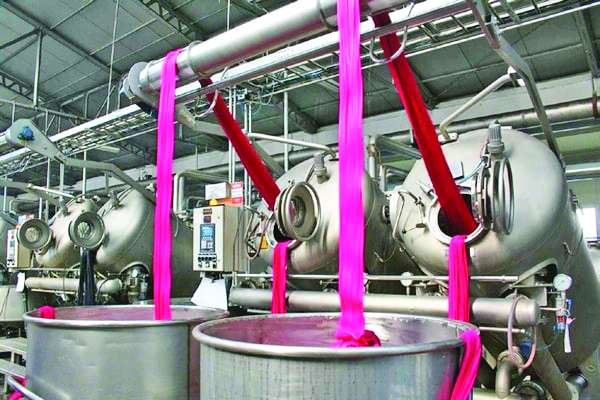
• Jet dyeing machine India’s Surat-based Apex Engineers (Fig 3), the most advanced machine for dispersing colouring polyester fabric is the jet dyeing machine. These machines allow for a speedier and more consistent dying process because the cloth and dye fluid are both in motion. There is no fabric driving reel to move the cloth in a jet dyeing machine. The force of the water helps the cloth move. It is affordable because of the low alcohol percentage. In contrast to a long tube dyeing machine, only four valves are needed to regulate the movement of the cloth, making it more user-friendly. There is only one valve in jet dyeing equipment and fabric dyeing machines.

Conclusion 

These are some of the highly automated, effective machines that are now utilised in the textile manufacturing sectors and that will also alter the course of production in the future. The textile industry is not only evolving but also revolutionising itself. It is on the cusp of a new era, promising textiles that are not just functional but also environmentally conscious. With each advancement, the fabric of our future becomes brighter and more technologically advanced than ever before. 

Share.
Exit mobile version