


Trending Insights
Powerplay Hits $10 Million Annualised Gross Run Rate; Expands Embedded Credit and AI Infrastructure for India’s Construction Sector JCBL South Manufactures 1,000 CSC Certified Containers for GE Vernova’s US Renewable Energy Market NORD DRIVESYSTEMS at SPS Italia 2026: intelligent drive solutions for the connected factory Schneider Electric and Allied Engineers Join Hands to Advance Intelligent and Reliable Power Distribution Infrastructure Byteseal Introduces Biometric Password Security Solution to Strengthen Digital Identity Protection Rittal India Appoints Mathew Jacob as Chief Executive Officer NORD DRIVESYSTEMS at LogiMAT 2026 in Stuttgart Eastman Impex Unveils Expansion Plan, Targets ₹1,200 Cr Revenue Why Indian Manufacturers Are Ready to Lead the Next Global Supply Chain Shift Rising Input Costs and Loan Burden: Is India’s Manufacturing Sector Under Pressure? CenturyPly Reclaims 30% of IT Workload and Turns Operations Into a Strategic Growth Engine Using ManageEngine Solutions NXP Collaborates with Quanta to Accelerate Deterministic Zonal Networking for Software Defined Vehicles Godrej Introduces India’s First Multi‑Ion Battery Technology for Forklifts, Advancing Clean and Efficient Supply Chains Fujiyama Power Systems Commissions 2,000 MW Solar Panel Manufacturing Facility Line TVS Motor Company Inducts Ravindran Shanmugam as an Independent Director Kennametal India’s Revenue Grows by 39% in the Quarter Ended March 2026 Yazaki India Welcomes Japanese Ambassador to Pune Plant 30 Years of TwinCAT by Beckhoff A Single Platform for All Automation Functions Mascot Dynamics and Amrut Energy Announce Strategic Merger Engineering Smarter Manufacturing Through Advanced Abrasives, Bonding & Sustainable Efficiency From Fragmentation to Flow: How AI is Rewiring Construction Project Execution MIC Electronics Limited Secures ₹3.78 Crore Environmental Lab Project in Chhattisgarh Greaves Cotton Appoints Vinay Pawar as Group Chief Technology Officer to Drive Technology-Led Growth From Blueprint to Execution: Integrated Development’s Contribution to Project Excellence 5 Steps to Make Sustainable Materials Move from Taboo to Mainstream Eastman Impex Accelerates Growth with ₹40 Cr YOY Annual Investment,  Expands Manufacturing Capabilities and Workforce in Punjab KPCL announces the results for FY26 Strengthening India’s Infrastructure Through Integrated Protection and Repair Solutions The Printer for The Smallest Details India’s Packaging Industry Gears Up as PackPlus 2026 Opens Registrations for Visitors and Exhibitors MIC Electronics Strengthens RailTech Footprint with New Central Railway Mandate for Project Expansion Cleaner Production Standards: Raising the Bar for Industrial Fertilisers Vinfast Launches the All-New Vf MPV 7, A Spacious Electric Seven-Seater for Indian Customers Henkel announces new sustainability targets for 2030 East Coast Railway Awards ₹2.12 Crore Contract to MIC Electronics for Passenger Information System Upgrade IEEMA Launches The 17th Edition of ELECRAMA 2027, The World’s Largest Electrical Show Collaboration Over Competition: How Software and Machine Makers Are Building Connected Manufacturing Ecosystems SWITCH Mobility Completes India’s Largest Electric Bus Export to Mauritius PC-based control for grid stability and efficient energy management QNu Labs Validates Real-World Performance of ARMOS QKD in Independent Global Study with VIAVI Advancing India’s Die & Mould Industry with Mazak’s High-Performance Machining Solutions Emperium Group Leverages Advanced Construction Technologies to Launch ‘Emperium Titan’ on Dwarka Expressway, Gurugram Transforming Textile Workflows with Ergonomic Vacuum Technology InsideFPV Secures and Executes ₹10 Crore Ministry of Defence Contract In Two Months Under EPR for Kamikaze Drones From Knowing Chemistry to Owning Process: India’s Next Industrial Leap India’s Manufacturing Moment: Why Engineering and Component Makers Are Key to Global Competitiveness Solitaire Unveils PTK 362 Pro PTZ Camera  Powerplay Launches India’s First AI Workforce for Construction SiMa.ai Introduces Modalix PCIe HHHL Card, Purpose-Built to Support LLMs for Industrial PCs and Edge Server Physical AI Applications Robotic Material Handling: Transforming the Future of Industrial Operations Zenergize partners with Infineon Technologies to strengthen power-electronics solutions for India’s clean-energy ecosystem Waaree Energies Powers Up as The Main Principal Partner for Rajasthan Royals Eurobond Opens Delhi Flagship Experience Centre, Shifting Architectural Sourcing from Desk Catalogues to Immersive Retail Navigating the Perfect Storm: Challenges Plaguing the Auto Components Sector in 2026 OXMIQ Labs and AM Intelligence Labs Partner to Architect one of the world’s largest renewable-powered AI compute platforms BenQ Introduces RD280UG, a New Standard in Visual Comfort and Focus for Modern Developers Bengaluru Gets a World-Class Electronics Co-Innovation Hub as Henkel Launches Advanced Application Centre Ember Cookware Appoints Amit Singh as Chief of Supply Chain and Services MIC Electronics Achieves Pan-India Railway Milestone with ₹1.53 Crore Multi-Zone ELU Orders LG Electronics India Brings Comprehensive HVAC Ecosystem to ACREX 2026 – Spanning Residential Comfort to Industrial-Scale Cooling Bharat Forge and Liebherr-Aerospace Launch Advanced Landing Gear Machining Facility in Pune FAULHABER BXI: Made for the Next Generation of Robotics Schneider Electric launches ‘One Unit Mission’ to Accelerate India’s Energy Efficiency Movement Why Software-Defined Vehicles Are Transforming Automotive Engineering, Ownership And Mobility Ecosystems Funding the Net-Zero Path: Carbon Capture Utilisation and Storage in Budget 2026 The Value-Centric Shift: How Global Manufacturing is Trading Optimization for Resilience Microscopy 4.0: Powering India’s Deep-Tech & Semiconductor Ambitions Alligator Automations Sets Up New PCMC Office in Pune to Strengthen Engineering and Operations Teams Fans Asked, Mahindra Listened: The BE 6 Batman Edition Returns Women Redefining Manufacturing Beckhoff Facilitates Physical AI Taking Automation to The Next Level With Natural Language NABL Accreditation Explained: What It Means forIndustrial Testing Labs in Bharat The End-to-End Process of Sheet-Metal Fabrication and Galvanising in Construction Supplies From Process Automation to Autonomous Coordination: Reimagining Manufacturing with Collaborative & Agentic AI Engineering Future-Ready Façade Solutions Through Innovation, Compliance & Sustainable Manufacturing Policy, Trade, and Incentives: A Roadmap for Sustaining Manufacturing Employment in India KPIT and IIT Bombay ink MOU to anchor cutting edge research and product development for next-gen mobility SiMa.ai and STIGA S.p.A. Announce Strategic Partnership in Physical AI The ePlane Company Unveils India’s Largest Integrated eVTOL Prototyping and Testing Facility at IIT Madras Discovery Campus University of Warwick’s study reveals Cleaner Solar Manufacturing Could Cut Global Emissions By 8.2 Billion Tonnes By 2035

India's Leading Magazine For Manufacturing Industries

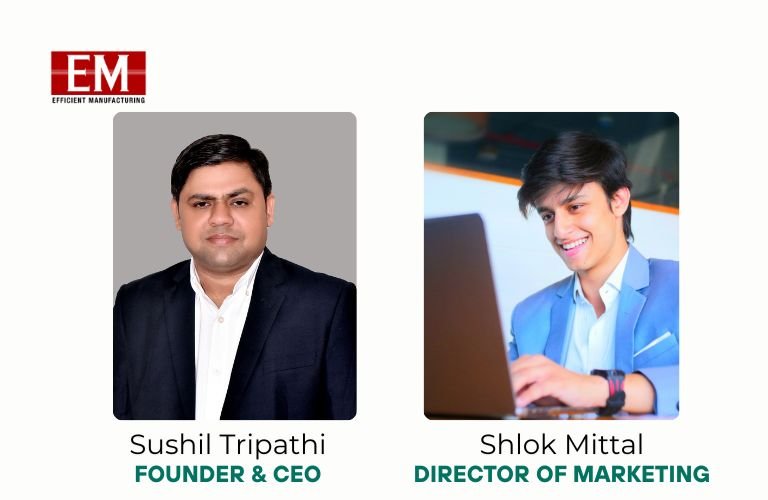
In this exclusive interview with Sushil Tripathi- Founder & CEO Biotic Organic Solutions, and Shlok Mittal- Director of Marketing for Biotic Organic Solutions we took an in-depth look at how Biotic Organic Solutions is leading the charge in revolutionizing aquaculture through organic, enzyme-based inputs. With its EMO series, the company combines cold fermentation technology and practical field-based solutions to enhance water quality, combat pathogens, and reduce dependency on harmful antibiotics. From scalable formulations that withstand extreme temperatures to hands-on farmer training and real-time quality validation, Biotic’s grounded approach is helping shape a more resilient, eco-friendly aquaculture future especially in key markets like Vietnam.

1. How do you see the market for organic, enzyme‑based inputs evolving over the next 3

5 years?

We believe that the market for organic, enzyme-based inputs is poised for exponential growth over the next 3–5 years, driven by increasing environmental awareness and the global shift towards sustainable, non-toxic solutions. With consumer preference for biodegradable and eco-friendly products rising at a rate of 12–15% annually, we can say that the demand is set to surge across industries like hospitality, manufacturing, and urban sanitation. At Biotic Organic Solutions, we are aligned with this momentum, continuously innovating to meet evolving needs. As regulations tighten and ESG goals become central, organic inputs will transition from niche alternatives to industry standards, making this sector one of the most promising in green innovation.

2. What technologies or proprietary techniques are involved in formulating and encapsulating the EMO series so that the enzymes and probiotics remain viable during storage, transport and in‑pond application?

We developed and formulated the EMO series using advanced cold fermentation technology, which preserves the integrity and activity of enzymes and probiotics during production. This method ensures that microbial strains remain viable and effective throughout the product lifecycle.  Our proprietary formulation process focuses on product stability, enabling the EMO series to withstand a wide temperature range—from -5°C to 60°C—making it suitable for diverse climatic and logistical conditions. Available in both, liquid and powder forms, the EMO series is designed to overcome transportation and storage challenges. For in-pond application, we provide a detailed Standard Operating Procedure (SOP) to farmers and offer hands-on training, both on-site and virtually, to ensure correct usage and optimal outcomes. This comprehensive approach not only enhances product efficacy but also empowers farmers to embrace sustainable, organic aquaculture practices, minimizing reliance on harmful antibiotics and

fertilizers while improving overall pond health. The EMO series visualizes a healthier and safer

aquaculture in Vietnam. 

3. Can you shed some light on how you control and monitor real‑time water‑quality? or

Do you have any IoT or sensor‑based monitoring platforms that integrate with your EMO treatments to provide real‑time water‑quality analytics and treatment optimization?

At Biotic Organic Solutions, real-time water quality monitoring is primarily based on observable

changes and empirical testing. We have observed that the first indication of improvement is often visual—the water becomes clearer and more transparent, showing enhanced quality. To further validate results, we encourage quality control tests using water samples from the treated pond or aquaculture farm. These samples are evaluated for key parameters such as TDS (Total Dissolved Solids), COD (Chemical Oxygen Demand), odour, smell, shrimp, tilapia (or other produce’s) health, etc. and also resulting and identification of production of more shrimps per cycle. These metrics help to determine the efficacy of our EMO treatments. The testing is typically conducted by the consumer or an associated technician, and the findings are documented in a structured feedback report. While we do not currently employ IoT or sensor-based platforms for real-time analytics, our approach emphasizes practical and scientific validation to ensure treatment optimization. We have learnt that this hands-on system supports transparent, result-driven monitoring for organic aquaculture water management.

4. With the integration of new technologies such as metagenomic profiling, AI‑driven strain selection or biotech scale‑up methods—are you exploring to extend your product line or tackle emerging aquaculture pathogens?

At Biotic Organic Solutions, our approach is rooted in practical feedback, direct client engagement, and real-time field data rather than AI-driven strain selection or metagenomic profiling. We analyse problems through five-year trends, face-to-face interactions, and current water or pond conditions to create customized, effective solutions. Each of our products clearly lists its microbial composition, ensuring transparency and precision. Our EMO series effectively combats emerging and harmful pathogens such as E. coli, Salmonella, Vibrio parahaemolyticus and Vibrio cholera further preventing EMS, WSSV, which are among the most critical in aquaculture today. This practical, need-based approach has shown proven success in Vietnamese aquaculture ecosystems.

(Replacing Antibiotics with Probiotics)

Share.
Exit mobile version