

Trending Insights
Solitaire Unveils PTK 362 Pro PTZ Camera  Powerplay Launches India’s First AI Workforce for Construction SiMa.ai Introduces Modalix PCIe HHHL Card, Purpose-Built to Support LLMs for Industrial PCs and Edge Server Physical AI Applications Robotic Material Handling: Transforming the Future of Industrial Operations Zenergize partners with Infineon Technologies to strengthen power-electronics solutions for India’s clean-energy ecosystem Waaree Energies Powers Up as The Main Principal Partner for Rajasthan Royals Eurobond Opens Delhi Flagship Experience Centre, Shifting Architectural Sourcing from Desk Catalogues to Immersive Retail Navigating the Perfect Storm: Challenges Plaguing the Auto Components Sector in 2026 OXMIQ Labs and AM Intelligence Labs Partner to Architect one of the world’s largest renewable-powered AI compute platforms BenQ Introduces RD280UG, a New Standard in Visual Comfort and Focus for Modern Developers Bengaluru Gets a World-Class Electronics Co-Innovation Hub as Henkel Launches Advanced Application Centre Ember Cookware Appoints Amit Singh as Chief of Supply Chain and Services MIC Electronics Achieves Pan-India Railway Milestone with ₹1.53 Crore Multi-Zone ELU Orders LG Electronics India Brings Comprehensive HVAC Ecosystem to ACREX 2026 – Spanning Residential Comfort to Industrial-Scale Cooling Bharat Forge and Liebherr-Aerospace Launch Advanced Landing Gear Machining Facility in Pune FAULHABER BXI: Made for the Next Generation of Robotics Schneider Electric launches ‘One Unit Mission’ to Accelerate India’s Energy Efficiency Movement Why Software-Defined Vehicles Are Transforming Automotive Engineering, Ownership And Mobility Ecosystems Funding the Net-Zero Path: Carbon Capture Utilisation and Storage in Budget 2026 The Value-Centric Shift: How Global Manufacturing is Trading Optimization for Resilience Microscopy 4.0: Powering India’s Deep-Tech & Semiconductor Ambitions Alligator Automations Sets Up New PCMC Office in Pune to Strengthen Engineering and Operations Teams Fans Asked, Mahindra Listened: The BE 6 Batman Edition Returns Women Redefining Manufacturing Beckhoff Facilitates Physical AI Taking Automation to The Next Level With Natural Language NABL Accreditation Explained: What It Means forIndustrial Testing Labs in Bharat The End-to-End Process of Sheet-Metal Fabrication and Galvanising in Construction Supplies From Process Automation to Autonomous Coordination: Reimagining Manufacturing with Collaborative & Agentic AI Engineering Future-Ready Façade Solutions Through Innovation, Compliance & Sustainable Manufacturing Policy, Trade, and Incentives: A Roadmap for Sustaining Manufacturing Employment in India KPIT and IIT Bombay ink MOU to anchor cutting edge research and product development for next-gen mobility SiMa.ai and STIGA S.p.A. Announce Strategic Partnership in Physical AI The ePlane Company Unveils India’s Largest Integrated eVTOL Prototyping and Testing Facility at IIT Madras Discovery Campus University of Warwick’s study reveals Cleaner Solar Manufacturing Could Cut Global Emissions By 8.2 Billion Tonnes By 2035 Kaynes Semicon Announces Strategic Adoption of Synopsys Simulation Software Mitsubishi Electric India hosts 6th ME Cup, Sona College of Technology emerges winner among 35 selected teams Make in India, Hire in Bharat: Manufacturing’s Next Constraint Is Not Capital Precision Engineering Technologies and WFL Join Forces to Accelerate Complete Machining Adoption Across Indian Manufacturing Showcasing the Future of Smart Manufacturing at B&R Innovations Day 2026 Indian Army Successfully validate “Advance 28-ft Heavy Drop System – 20T (Type V)” Configuration Auto Component Manufacturing and the EV Shift: Policy, Investment and Innovation Priorities QVI India Opens New Office and Advanced Demo Centre in Bengaluru Ashok Leyland Plans Big Expansion in Western India WIDIA Turns 100: Defining and Celebrating a Century of Metal Cutting Solutions ACMA Automechanika New Delhi marks a major milestone, attracting 35,750 visitors alongside robust global participation from 870 exhibitors IMTEX FORMING 2026 Asia’s Largest Exhibition on Metal Forming and Manufacturing Technologies Records Consistent Growth in Size and Business Orders Tata Advanced Systems inaugurates helicopter production line for Airbus H125 helicopter to boost India’s vertical-lift capabilities Scaling CAE for High-Volume Manufacturing Environments Sona Comstar Integrating AI, Robotics and Electronics to Build a World-Class Mobility Technology Company: Priya Kapur at India-AI Impact Summit 2026 iCreate Drone Challenge Demo Day Showcases 14 Homegrown Startups Advancing India’s Indigenous Drone Technologies India AI Impact Summit 2026 Commences at Bharat Mandapam with Unprecedented Global Participation LMT Tools India Unveils Nation’s Largest Gear Cutting Tool Plant in Chakan BorgWarner to Supply Variable Turbine Geometry Turbocharger for Major European OEMs’ Hybrid Electric Vehicle Platform MIC Electronics Secures ₹4.45 Crore Orders from Eastern Railway ACMA–BCG Joint Study Highlights Smart Factories as a Key Enabler of India’s Auto Component Growth & Competitiveness CNH India Leads the Mechanization Movement with World-Class Crop Solutions Steelbird International Showcases Automotive Component Portfolio at ACMA Automechanika 2026 RODIM Launches R-Star Advanced Paint Protection Film at Automechanika 2026 Synopsys to Showcase AI-Driven Engineering Innovation at India AI Impact Summit 2026 Adhesive Dispensing in Automotive Body Shops: Driving Safety, Efficiency, and Durability MAHLE HeatX Range+ for More Range in Winter RIR Power Electronics Limited appoints N Ramesh Kumar as Managing Director and Chief Executive Officer Euler Motors and Jio-bp partner to accelerate EV charging infrastructure for commercial electric vehicles in India ACMA welcomes the India–US Trade Interim Agreement Framework Hindustan Zinc and Jawaharlal Nehru Centre for Advanced Scientific Research Advance Zinc-Ion Battery Technology for Large-Scale Energy Storage Cobots for Precision Manufacturing ACMA Automechanika New Delhi 2026 opens, spotlighting India’s global aftermarket ambitions Addverb Unveils Elixis-W, Its First Wheeled Humanoid, and Advanced Intralogistics Solutions at LogiMAT India 2026 How India Is Building Its Semiconductor Future Enabling India’s NextChapter in Sustainable, High-Performance Manufacturing Mahindra bags its biggest ever export order; 35,000 units of LCVs to be delivered to Agrinas Pangan Nusantara, Indonesia in 2026 Manufacturing the Future: Reforms, Technology, and the Road to Viksit Bharat 2047 Landmark US-India Trade Deal Eases Tariffs, Opens New Opportunities for Indian Industry SIAM Hosts 20th Styling & Design Conclave and 18th Automotive Design Challenge LSKB Aluminium Foils and JUPALCO Host Global Aluminium Foil Industry Leaders at Sonipat Facility During GLAFCO 2026 Budget 2026 Signals a Manufacturing-Led Growth Push Across Strategic Sectors Union Budget 2026: Manufacturing Industry Sets Its Expectations Customisable E-Rickshaws: The Rising Trend in Commercial Mobility Breaking the Bandwidth Barrier: How Co-Packaged Optics is Redefining High-Speed Connectivity Eastman IMPEX Showcased Advanced Formwork, Shoring and Scaffolding Solutions at World of Concrete 2026

India's Leading Magazine For Manufacturing Industries

As India rapidly embraces Industry 4.0, automation and robotics are no longer optional; they are essential tools for increasing productivity, ensuring consistent quality, and staying competitive in global markets. Whether in automotive plants, electronics assembly lines, logistics warehouses, or food processing units, robots are transforming how materials are handled, assembled, and packed. But the performance of these robots depends not only on their speed or programming, it hinges on how reliably they can pick, hold, and place parts. This is where gripping systems, especially vacuum-based solutions, play a defining role.

The gripper is the robot’s physical link to the workpiece. It determines how safely a carton, a metal plate, or a glass vial is picked without damage. It affects cycle time, placement accuracy, and whether a robot can switch quickly between different parts or products. A poorly chosen gripper can cause slippage, misalignment, or even production stoppages. That’s why Schmalz, a global leader in vacuum automation, is at the forefront of developing smart, adaptive, and efficient gripping systems for a wide range of manufacturing tasks. Their solutions are not just tools—they are enablers of seamless automation, tailored to meet the growing diversity of Indian manufacturing industries.

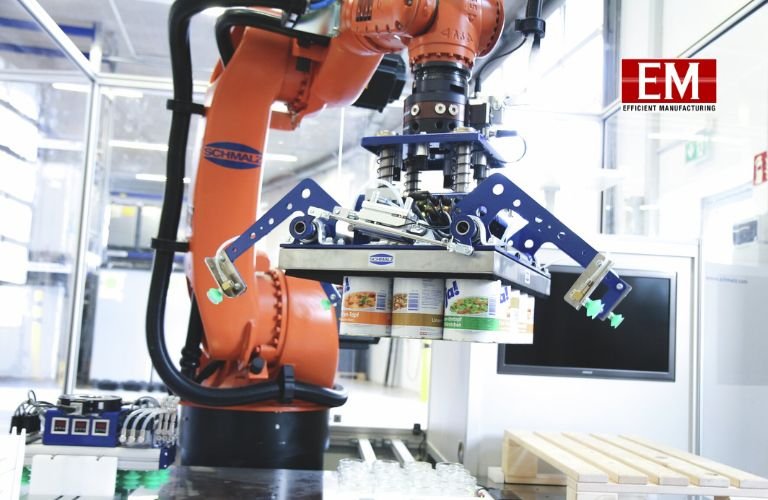
In high-speed material flow applications like palletising and de-palletising, common in logistics, automotive, or food & beverage sectors, Schmalz offers the Vacuum Layer Gripper SPZ, engineered to lift entire layers of cartons, cans, or bags quickly and securely. What makes the SPZ unique is its large-area vacuum contact and ability to gently yet firmly grip even slightly uneven surfaces without damaging packaging. For production environments that require picking and placing varied or fragile items, like electronics boards, glass packaging, or delicate consumer goods, the FQE Area Gripper delivers reliable performance with maximum flexibility. Its broad sealing surface conforms to different product shapes, while the integrated ejectors ensure fast gripping and release cycles. The FQE is also highly compact and lightweight, which allows faster robot movements and energy-efficient operation. Importantly, its smooth contours and safety-compliant design make it suitable for collaborative use, such as in shared workspaces between humans and robots in light assembly or quality inspection cells.

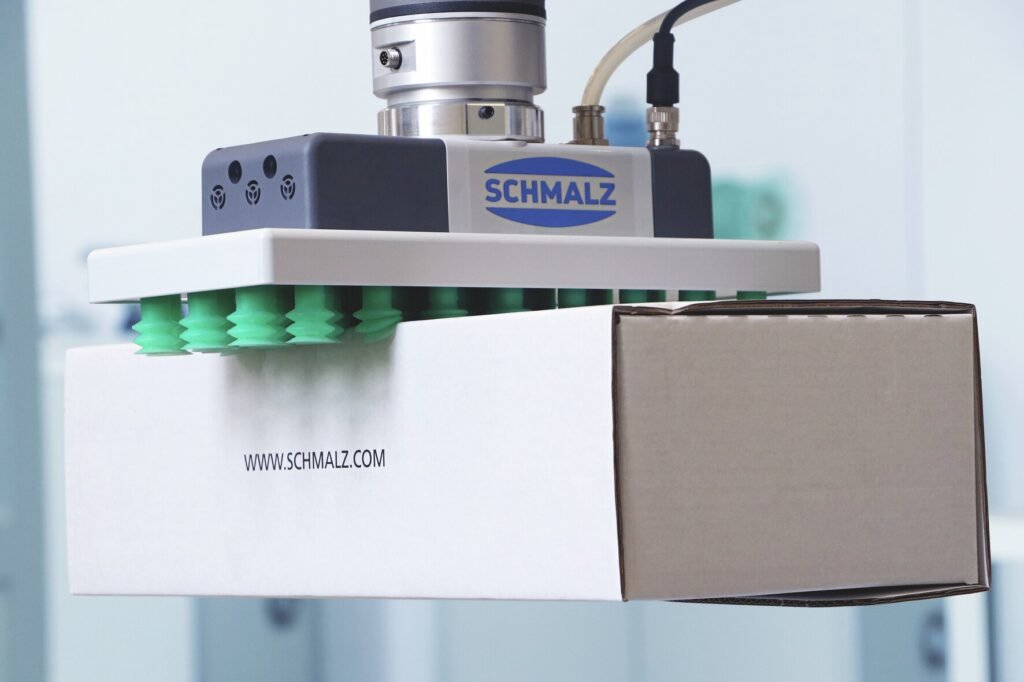
FQE

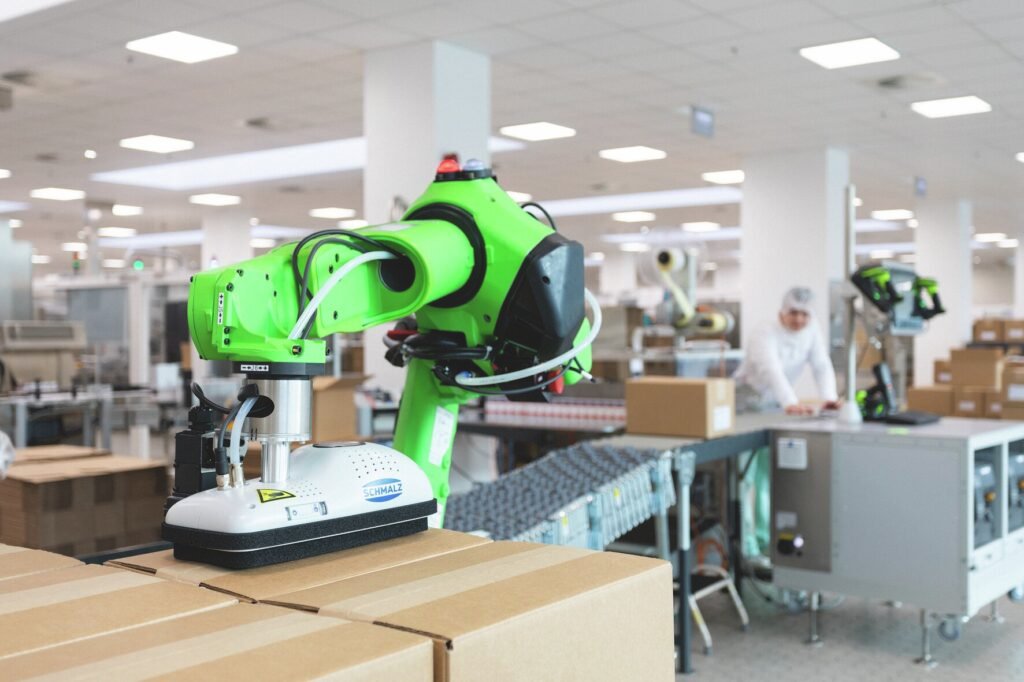
For dedicated collaborative robotics (cobot) applications, Schmalz has developed the FXCB and FMCB series, specially designed to work alongside people. These grippers combine a safe, rounded design with smart functionality, like built-in vacuum generation, lightweight construction from 3D-printed materials, and plug-and-play integration using standard robot flanges. Whether in automotive kitting, pharmaceutical packaging, or food-grade environments, these grippers enable robots to perform repetitive or ergonomic tasks safely while maximising their payload and reach. Their simplicity in setup and quick changeovers allow manufacturers to deploy cobots flexibly, without needing in-depth programming or custom hardware each time a new product is introduced.
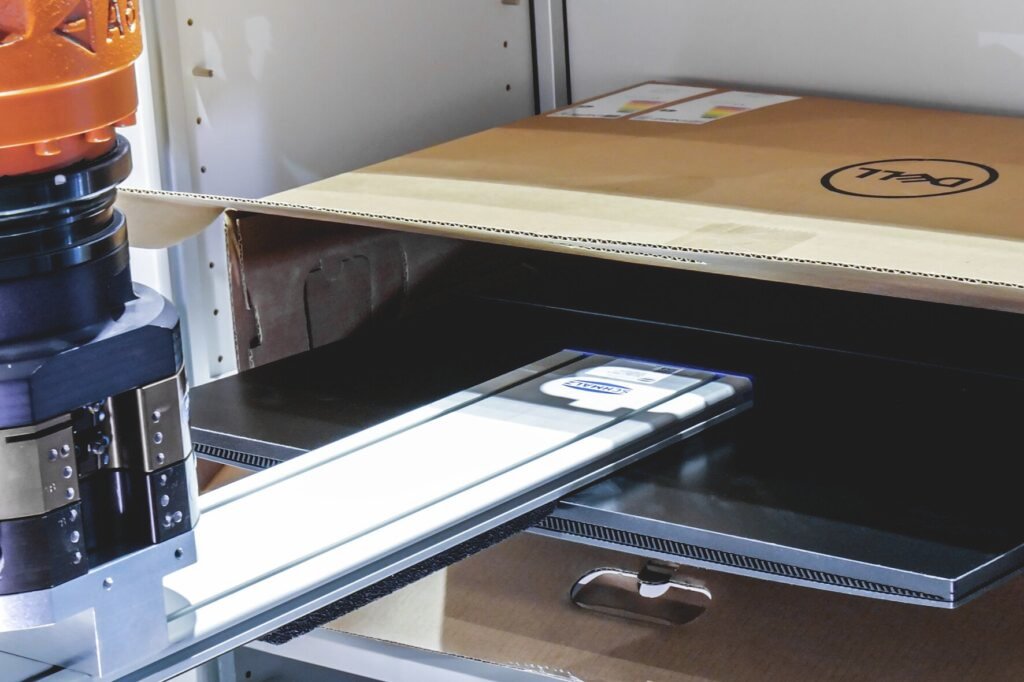
For automation tasks involving flat, sealed workpieces, the Vacuum Area Gripping System FEL offers a lightweight and cost-effective solution. Designed for efficient handling of uniform surfaces, the FEL is ideal for picking items such as delicate electronic componentslike laptop, tablet, mobile, small display screens and flat-glass elements. Its compact design integrates vacuum generation directly within the unit, eliminating the need for external ejectors and simplifying installation, especially in space-constrained robotic arms or gantry systems. The gripper’s rigid housing and replaceable foam sealing pad ensure consistent suction and reliable surface contact without damaging sensitive parts. As a result, the FEL is being used in industries ranging from electronics assembly and packaging to intralogistics and light industrial automation, where ease of integration, cycle-time stability, and part safety are critical.
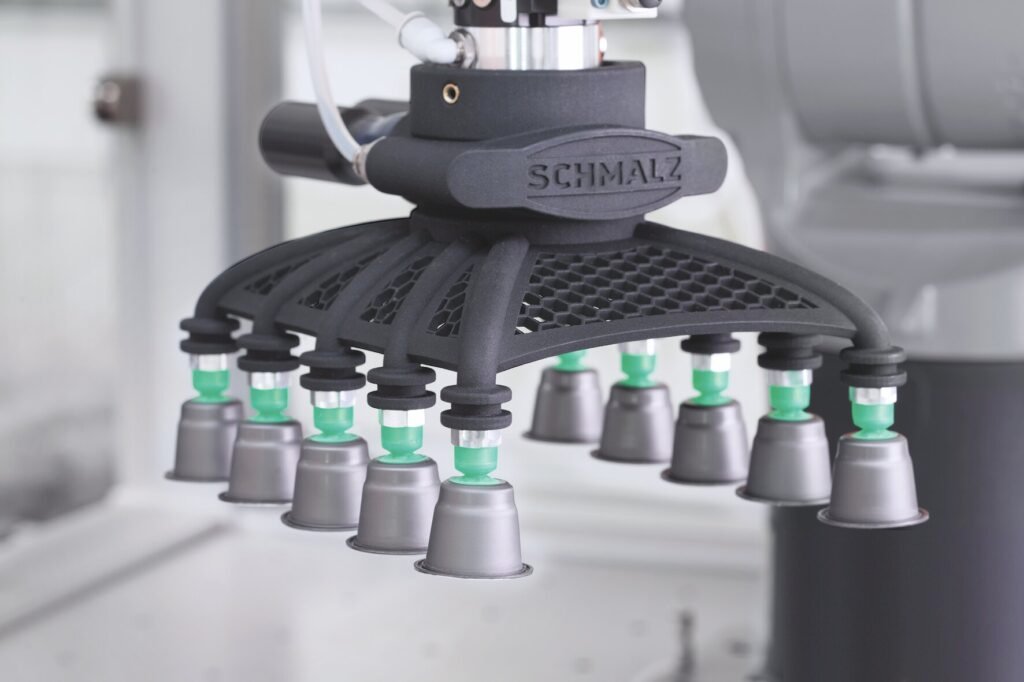
SLG

Meanwhile, the SLG Lightweight Gripper is ideal for customised handling of small components using cobots or compact robotic arms. Thanks to additive manufacturing, the SLG can be tailor-made to match the shape, spacing, and handling needs of the specific parts being moved. This makes it particularly suitable for electronics, plastics, cosmetics, and consumer goods industries, where product shapes vary frequently. Despite being extremely lightweight, the SLG delivers a reliable holding force and supports high dynamic movements. Its modular, ready-to-connect design speeds up integration, allowing automation experts to quickly deploy and redeploy it across different workstations without sacrificing performance or precision.

What ties all these gripping systems together is the tangible benefit they offer to Indian manufacturers. With Schmalz grippers, users see faster cycle times, fewer product defects and increased throughput, whether handling 50-gram vials or 50-kg component layers. Their modular and lightweight designs mean easier integration into existing lines, while the robust construction ensures long service life and minimal downtime. More importantly, these systems reduce physical strain on human operators by automating repetitive, heavy, or awkward manual handling tasks, supporting a safer and more productive shop floor.

In a market that demands speed, agility, and reliability, Schmalz gripping systems are enabling the next generation of Indian automation, built on smarter gripping, not just smarter robots.

Courtesy: Schmalz India

Share.
Exit mobile version