



Trending Insights
Strategic Capital, Strong Foundations: ELV Projects’ Growth Roadmap with Institutional Backing India’s AI Moment: Why Copyright could make or break innovation RSB Group pledges to achieve 50% renewable energy adoption and 45% Emissions Cut by 2030 BenQ Launches BSH and BDH Monitor Arms: Premium Ergonomic Workspace Solutions Built by Trusted Monitor Experts Eastman Impex Strengthens Global Outreach at MITEX 2025 in Moscow QAD | Redzone Marks 20 Years in India and Unveils the Next Era of Intelligent Manufacturing at Champions of Manufacturing India 2025 SquadStack.ai Launches In-App Voice AI Assistant to Reimagine Digital Customer Journeys AI in Manufacturing: How Predictive Tech Is Redefining Quality and Cost in Consumer Durables Kirloskar Group Unveils ‘Made in Kirloskar’ Initiative, Celebrating Engineers, Engineering and the Spirit of Making EMCO Mecof MEGAMILL: the giant milling machine that combines power, precision and connectivity Rohit Markan Appointed Executive Vice President AsiaPacific For Continental’s Industrial Solutions Business The World’s Leading Industrial Fair, HANNOVER MESSE, Returns Reinvented for 2026 Cummins India Showcases its Next-Generation Power Portfolio for Infrastructure and Construction at EXCON 2025 Tata Motors leads the way with innovative, sustainable and intelligent mobility solutions at EXCON 2025 Mahindra unveils its New Mini Compactor, ‘COMPAX’ for Road Construction Industry with cutting-edge Technology Building the Future of Mobility: India’s EV Progress Through Hybrid Manufacturing and System Integration EUROBOND launches EURODUAL, becomes one of the first Indian Brands to produce Engineered Solid Panels Uno Minda Takes Full Control of EV Components JV, Announces ₹40 Crore Investment Kinetiq Rrobotics Concludes a Successful Showcase at Clean India Show 2025 — A Strong Market Debut Backed by Star Engineers’ 37-Year Legacy VIAVI and QNu Labs Partner to Accelerate Quantum-Safe Network Security Toyota Kirloskar Motor Signs MoU with Government of Nagaland to Implement Strategic CSR Initiatives Knauf India Doubles Production Capacity at Khushkhera Plant, Strengthens Manufacturing Footprint Mitsubishi Electric India to Showcase Breakthrough Power Semiconductor Technologies at PCIM India 2025 Kennametal to Showcase Advanced Earth Cutting Tools and Wear Protection Solutions at EXCON 2025 in Bengaluru Alligator Automations Unveils Its ₹40-Crore State-of-the-Art Plant to Boost Capacity and International Reach Jyoti Global Plast Unveils AeroCrop Agricultural UAS Mphasis’ Sparkle Innovation Program joins forces with Startups to accelerate next-gen innovation for clients Finolex Industries announces leadership changes, Poised for continued growth ANAND Group Appoints Mohua Mandal as Senior GM & Head of Group Communications SCG Partners with Rondo Energy To Launch ‘Southeast Asia’s First Industrial Heat Battery’, Unlocking 24-Hour Clean Energy Storage for Industry JSW Defence Commences Construction of Next-Gen UAS Facility in Hyderabad MAHLE and Jumana Al-Sibai part ways The Coolest Partnership Ever: Panasonic Brings “Captain Cool” MS Dhoni on board Saatvik Green Energy Limited achieves prestigious CII-IGBC Green Factory Building silver rating for its Ambala manufacturing facility EMO – the world’s leading trade fair for production technology to remain in Hanover How AI-Powered, Secure-by-Default Systems Can Drive Scalable Growth in Industry 4.0 Bridgestone India Expands Retail Footprint in Punjab with New Select Store in Firozpur Ultraviolette Expands To Six Locations Across Mumbai and Pune, Within 48 Hours Fronius presents the Velocity Assistant for manual MIG/MAG welding Engineering Hardware to be India’s Next Billion-Dollar Opportunity, says Hardware Industry Startup Ecosystem Report by CII, KPMG, and Synopsys HMS Networks launches new N-Tron® unmanaged industrial Ethernet switches to support mission-critical operations in rugged environments YugX Announces Strategic Partnership with MP Lifts Honeywell to help Dangote double production capabilities at Africa’s largest refinery Eastman Showcases Indian Engineering Excellence at the 138th Canton Fair Euler Motors rolls out‘Euler Prime’,a preemptive on-the-spot support solution for customers in 45+ cities BASF inaugurates the expansion of production capacity for Alkyl Polyglucosides (APGs) in Bangpakong, Thailand SKF India Strengthens Automotive Marketing Leadership Stability meets versatility – for all materials and grooving applications Success in China: Evermore Counts on Cylindrical Grinding Machines From STUDER Montra Electric Strengthens Presence in Northeast India with New Exclusive e-3W Dealership in Silchar Silmax Expands Global Footprint with New Manufacturing Facility in Bengaluru Star Engineers and ConnectM Form StarConnectM LLP to Drive the Future of Smart Mobility Vertiv Training Academy & Technology Excellence Center Launched in Pune, India, Reinforcing Dedication to Talent Development and Operational Excellence Kennametal India Board Approves INR 680 Million Capital Expenditure for Machining Solutions Group Greenfield Project Kalyani Strategic Systems Ltd (KSSL) – Securing our seas with Unmanned & Marine Systems Federal Card Services enters India with an investment of USD 250 million; first manufacturing unit coming up in Pune GHCL partners with AuthBridge to strengthen ESG compliance across the supplier ecosystem Hindustan Zinc empowers over 10 Lakh young minds through quality education in the last 5 years Novo Nordisk India partners with Emcure Pharma to commercialise Poviztra® in India as a second brand of Wegovy® BorgWarner Expands Dual Inverter Collaboration with Great Wall Motor Empowering India’s Semiconductor Revolution: Henkel’s Commitment to Sustainable Innovation SquadStack.ai Becomes World’s First Voice AI Company to Pass the Turing Test Schneider Electric Appoints Amit Sharma as Vice President – Power Products & Digital Energy for Greater India Eurobond Announces Entry into European Market with Launch of Eurobond Europe Loom Solar Expands Manufacturing Footprint and Product Portfolio, Reinforcing Leadership in India’s Solar and Storage Market at REI 2025 Otter Controls India Unveils $4.5 Million Manufacturing Facility in Pune, creating 1,000 New Jobs and Boosting Production Capacity by 75% Kennametal to Present Advanced Wire and Cable Manufacturing Solutions at Cable and Wire Fair 2025 in New Delhi Wipro to Power HanesBrands’ GenAI-led IT 2.0 Transformation Balancing Local Sourcing vs. Importing: Effect of Tariffs on Material Choices for Formwork & Construction Components ACMA Mobility Foundation hosts conference on “Decoding Taxation & ESG” to help businesses navigate India’s evolving regulatory landscape How Smart Automation is Redefining Textile Manufacturing Tata Advanced Systems in partnership with Safran inaugurates state-of-the-art rotating parts manufacturing facility for the LEAP engine Kennametal to Showcase its Latest Tooling and Wear-Resistant Solutions for Mining Industry at IME 2025 in Kolkata Sona BLW Precision Forgings Ltd. announces Q2 FY26 Results HARMAN Invests ₹345 Crore to Expand Pune Automotive Manufacturing Plant, Accelerating India’s Role in the Future of Connected & Sustainable Mobility Top 10 Agentic AI Threats, And How to Defend Against Them ZF Restructures Leadership, Appoints Andreas Moser to Board of Management From NEOM to India: Lessons from Global Hydrogen Projects Powering India’s Clean Energy Goals Sujan Industries Advances Railway Safety and Efficiency with New AI-Powered Solutions at IREE 2025 GROB, Kennametal, Renishaw, and OPEN MIND Host Successful Technology Evening in Pune

India's Leading Magazine For Manufacturing Industries

The Dialogue’s latest study draws global lessons to propose a pragmatic, innovation-friendly framework for AI and copyright policy

The Dialogue, a leading public policy think tank working at the intersection of technology, law, and society, has released a comprehensive new report examining how India can strike a principled and future‑ready balance between accelerating artificial intelligence (AI) innovation and safeguarding copyright interests.

Titled “Policy Prescriptions for Balancing AI and Copyright Concerns,” the report offers a comprehensive global compass, analyzing how major jurisdictions are approaching AI training and copyright and distilling practical lessons for India’s rapidly growing AI and creative ecosystems.

Drawing on a detailed review of legal frameworks in the  United States, European Union, United Kingdom, Canada, China, Japan, and Singapore, the report maps the diverse legal approaches for AI training, highlighting their respective strengths, limitations, and real‑world implications. For each jurisdiction studied, it  examines the governing legal instruments, their impact on AI training, the opportunities they create for innovators, rightsholders, and the public, as well as the risks and unresolved legal questions that remain. This comparative framework is designed to help Indian policymakers learn from international experience while avoiding regulatory pitfalls that could either stifle innovation or erode creator protections.

Building on this analysis, the report sets out a set of forward‑looking policy prescriptions tailored to India. Key recommendations include enacting a broad, technologically neutral statutory exception for text and data mining that covers both commercial and non‑commercial AI training; exploring the feasibility of voluntary opt-outs; promoting metadata and attribution standards to support responsible data sourcing; and adopting a guidance‑first regulatory approach that prioritizes best‑effort compliance over punitive enforcement. The report also emphasizes the importance of addressing downstream harms, such as deepfakes, voice cloning, and unauthorized use of likeness, through targeted safeguards and output‑focused regulation.

In addition to policy guidance for policymakers, the report outlines practical steps for AI developers and rightsholders alike. It encourages  developers to strengthen dataset provenance practices, filter out clearly pirated content, and pursue selective licensing where risks are highest. At the same time, it encourages creators to focus enforcement efforts on demonstrable output‑level harm and to explore collaborative, co‑creation models with AI companies that unlock new value for both sectors.

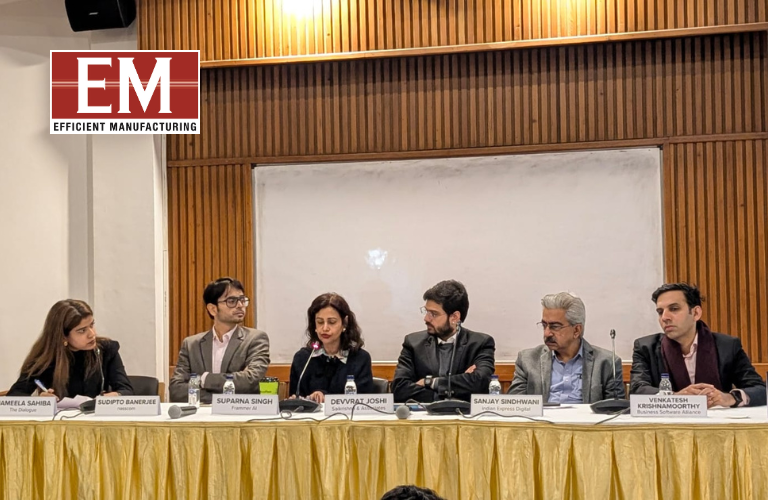
During the report launch, the panelists also reflected on  the challenges of the recently released DPIIT report’, particularly its recommendations for  a hybrid mandatory licensing model, supplemented by a government-led rate-setting body. Suparna Singh, CEO of Frammer AI said “Enabling innovation and maximum-benefit-for-all have to be the guiding principles for India’s approach to its AI–copyright framework if we want Indian companies to have a fair chance at competing internationally. Mandatory licensing or government-determined pricing, however well-intentioned, rarely work. The  market will- and should – determine  what content or data is worthy of use, and how much it should cost.”.

Sanjay Sidhwani, CEO, The Indian Express Digital stated,  “There is broad alignment on acknowledging copyright, infringement, and need for compensation, but the proposed approach risks oversimplifying a deeply complex issue. In news, for instance, the value of archival content varies enormously: a century-old newspaper may carry unique historical exclusivity, while recent decades are far more saturated, yet compensation methodology won’t distinguish between historical archives and recently created content. A one-size-fits-all framework cannot reflect these realities.

Venkatesh Krishnamoorthy, Country Manager-India, Business Software Alliance (BSA) also mentioned, “India’s AI strategy must be anchored in accelerating AI adoption across sectors and enterprises of all sizes, because adoption and development are interconnected. Users adopt AI only when it delivers value, and without adoption, innovation itself stalls. As the government has rightly recognised through the IndiaAI Mission, this is a once-in-a-generation opportunity for India to leapfrog in AI development and deployment. At the same time, policy must remain grounded in technical and economic realities. The assumption that individual works used in large-scale model training can be precisely identified, valued, and remunerated, that too retrospectively, raises serious feasibility concerns. AI models are trained on millions of data points transformed into abstract representations, where the marginal value of any single dataset is obscure. Supporting innovation therefore requires a balanced framework, one that enables responsible AI training and adoption while avoiding jumping to regulatory approaches that could unintentionally slow industry and undermine India’s AI momentum.

All panellists emphasised  the importance of sustained  multistakeholder engagements before any policy direction is finalised. Through its report, The Dialogue seeks to advance a balanced, evidence-based approach and also aims to reframe the AI‑copyright debate away from zero‑sum conflict and toward constructive solutions that support innovation, creativity, and public interest together.

The full report, Policy Prescriptions for Balancing AI and Copyright Concerns,” is now available on The Dialogue’s website:

Share.
Exit mobile version