


Trending Insights
From Knowing Chemistry to Owning Process: India’s Next Industrial Leap India’s Manufacturing Moment: Why Engineering and Component Makers Are Key to Global Competitiveness Solitaire Unveils PTK 362 Pro PTZ Camera  Powerplay Launches India’s First AI Workforce for Construction SiMa.ai Introduces Modalix PCIe HHHL Card, Purpose-Built to Support LLMs for Industrial PCs and Edge Server Physical AI Applications Robotic Material Handling: Transforming the Future of Industrial Operations Zenergize partners with Infineon Technologies to strengthen power-electronics solutions for India’s clean-energy ecosystem Waaree Energies Powers Up as The Main Principal Partner for Rajasthan Royals Eurobond Opens Delhi Flagship Experience Centre, Shifting Architectural Sourcing from Desk Catalogues to Immersive Retail Navigating the Perfect Storm: Challenges Plaguing the Auto Components Sector in 2026 OXMIQ Labs and AM Intelligence Labs Partner to Architect one of the world’s largest renewable-powered AI compute platforms BenQ Introduces RD280UG, a New Standard in Visual Comfort and Focus for Modern Developers Bengaluru Gets a World-Class Electronics Co-Innovation Hub as Henkel Launches Advanced Application Centre Ember Cookware Appoints Amit Singh as Chief of Supply Chain and Services MIC Electronics Achieves Pan-India Railway Milestone with ₹1.53 Crore Multi-Zone ELU Orders LG Electronics India Brings Comprehensive HVAC Ecosystem to ACREX 2026 – Spanning Residential Comfort to Industrial-Scale Cooling Bharat Forge and Liebherr-Aerospace Launch Advanced Landing Gear Machining Facility in Pune FAULHABER BXI: Made for the Next Generation of Robotics Schneider Electric launches ‘One Unit Mission’ to Accelerate India’s Energy Efficiency Movement Why Software-Defined Vehicles Are Transforming Automotive Engineering, Ownership And Mobility Ecosystems Funding the Net-Zero Path: Carbon Capture Utilisation and Storage in Budget 2026 The Value-Centric Shift: How Global Manufacturing is Trading Optimization for Resilience Microscopy 4.0: Powering India’s Deep-Tech & Semiconductor Ambitions Alligator Automations Sets Up New PCMC Office in Pune to Strengthen Engineering and Operations Teams Fans Asked, Mahindra Listened: The BE 6 Batman Edition Returns Women Redefining Manufacturing Beckhoff Facilitates Physical AI Taking Automation to The Next Level With Natural Language NABL Accreditation Explained: What It Means forIndustrial Testing Labs in Bharat The End-to-End Process of Sheet-Metal Fabrication and Galvanising in Construction Supplies From Process Automation to Autonomous Coordination: Reimagining Manufacturing with Collaborative & Agentic AI Engineering Future-Ready Façade Solutions Through Innovation, Compliance & Sustainable Manufacturing Policy, Trade, and Incentives: A Roadmap for Sustaining Manufacturing Employment in India KPIT and IIT Bombay ink MOU to anchor cutting edge research and product development for next-gen mobility SiMa.ai and STIGA S.p.A. Announce Strategic Partnership in Physical AI The ePlane Company Unveils India’s Largest Integrated eVTOL Prototyping and Testing Facility at IIT Madras Discovery Campus University of Warwick’s study reveals Cleaner Solar Manufacturing Could Cut Global Emissions By 8.2 Billion Tonnes By 2035 Kaynes Semicon Announces Strategic Adoption of Synopsys Simulation Software Mitsubishi Electric India hosts 6th ME Cup, Sona College of Technology emerges winner among 35 selected teams Make in India, Hire in Bharat: Manufacturing’s Next Constraint Is Not Capital Precision Engineering Technologies and WFL Join Forces to Accelerate Complete Machining Adoption Across Indian Manufacturing Showcasing the Future of Smart Manufacturing at B&R Innovations Day 2026 Indian Army Successfully validate “Advance 28-ft Heavy Drop System – 20T (Type V)” Configuration Auto Component Manufacturing and the EV Shift: Policy, Investment and Innovation Priorities QVI India Opens New Office and Advanced Demo Centre in Bengaluru Ashok Leyland Plans Big Expansion in Western India WIDIA Turns 100: Defining and Celebrating a Century of Metal Cutting Solutions ACMA Automechanika New Delhi marks a major milestone, attracting 35,750 visitors alongside robust global participation from 870 exhibitors IMTEX FORMING 2026 Asia’s Largest Exhibition on Metal Forming and Manufacturing Technologies Records Consistent Growth in Size and Business Orders Tata Advanced Systems inaugurates helicopter production line for Airbus H125 helicopter to boost India’s vertical-lift capabilities Scaling CAE for High-Volume Manufacturing Environments Sona Comstar Integrating AI, Robotics and Electronics to Build a World-Class Mobility Technology Company: Priya Kapur at India-AI Impact Summit 2026 iCreate Drone Challenge Demo Day Showcases 14 Homegrown Startups Advancing India’s Indigenous Drone Technologies India AI Impact Summit 2026 Commences at Bharat Mandapam with Unprecedented Global Participation LMT Tools India Unveils Nation’s Largest Gear Cutting Tool Plant in Chakan BorgWarner to Supply Variable Turbine Geometry Turbocharger for Major European OEMs’ Hybrid Electric Vehicle Platform MIC Electronics Secures ₹4.45 Crore Orders from Eastern Railway ACMA–BCG Joint Study Highlights Smart Factories as a Key Enabler of India’s Auto Component Growth & Competitiveness CNH India Leads the Mechanization Movement with World-Class Crop Solutions Steelbird International Showcases Automotive Component Portfolio at ACMA Automechanika 2026 RODIM Launches R-Star Advanced Paint Protection Film at Automechanika 2026 Synopsys to Showcase AI-Driven Engineering Innovation at India AI Impact Summit 2026 Adhesive Dispensing in Automotive Body Shops: Driving Safety, Efficiency, and Durability MAHLE HeatX Range+ for More Range in Winter RIR Power Electronics Limited appoints N Ramesh Kumar as Managing Director and Chief Executive Officer Euler Motors and Jio-bp partner to accelerate EV charging infrastructure for commercial electric vehicles in India ACMA welcomes the India–US Trade Interim Agreement Framework Hindustan Zinc and Jawaharlal Nehru Centre for Advanced Scientific Research Advance Zinc-Ion Battery Technology for Large-Scale Energy Storage Cobots for Precision Manufacturing ACMA Automechanika New Delhi 2026 opens, spotlighting India’s global aftermarket ambitions Addverb Unveils Elixis-W, Its First Wheeled Humanoid, and Advanced Intralogistics Solutions at LogiMAT India 2026 How India Is Building Its Semiconductor Future Enabling India’s NextChapter in Sustainable, High-Performance Manufacturing Mahindra bags its biggest ever export order; 35,000 units of LCVs to be delivered to Agrinas Pangan Nusantara, Indonesia in 2026 Manufacturing the Future: Reforms, Technology, and the Road to Viksit Bharat 2047 Landmark US-India Trade Deal Eases Tariffs, Opens New Opportunities for Indian Industry SIAM Hosts 20th Styling & Design Conclave and 18th Automotive Design Challenge LSKB Aluminium Foils and JUPALCO Host Global Aluminium Foil Industry Leaders at Sonipat Facility During GLAFCO 2026 Budget 2026 Signals a Manufacturing-Led Growth Push Across Strategic Sectors Union Budget 2026: Manufacturing Industry Sets Its Expectations Customisable E-Rickshaws: The Rising Trend in Commercial Mobility

India's Leading Magazine For Manufacturing Industries

| India’s Electric Vehicle (EV) industry has a come long way since the launch of EVs such as Lovebird (by Eddy Electric) Reva (by Mahindra) to name a few. However, limited infrastructure and high costs kept electric vehicles from becoming mainstream, confining them to a niche market. Since then, the Indian EV industry has come a long way, and it’s experiencing a phase of rapid adoption. This has put India on the map for electric mobility.

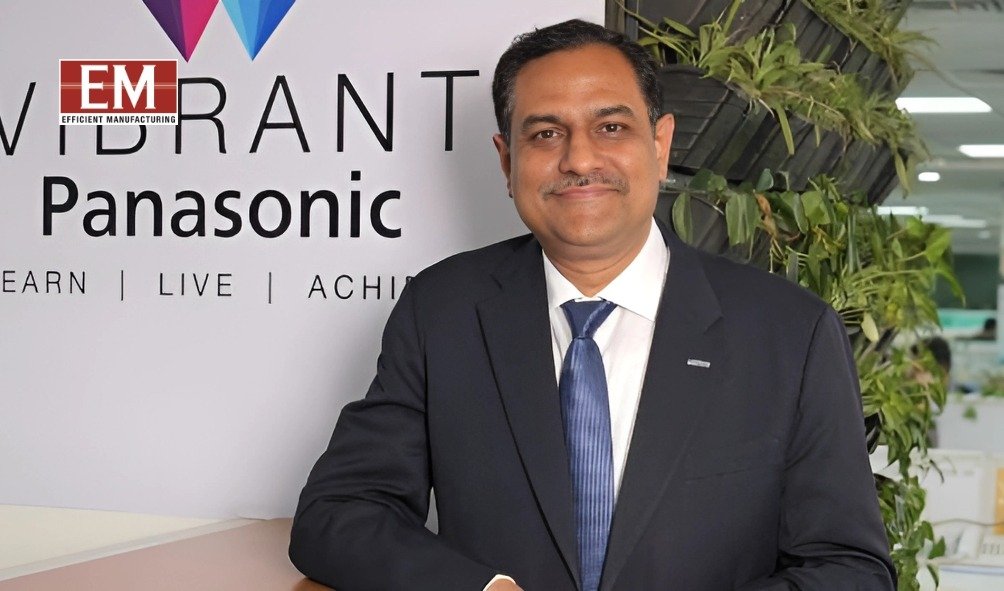
Narayan Kumar, 
Divisional Director – Industrial Devices Division, 
Panasonic Life Solutions India

A major turning point came in 2015 with the launch of the Faster Adoption and Manufacturing of Hybrid and Electric Vehicles (FAME) scheme. This government initiative provided financial support for both EV adoption and charging infrastructure development. This gave the EV industry a significant boost and we may witness a surge in EV adoption, particularly in two- and three-wheeler segments, where four-wheelers are catching up fast. 

In 2023, total EV sales reached 1.53 million, up from 1.02 million in 2022, showing a strong trend in EV adoption. According to the Economic Survey of India 2023, the domestic electric vehicle market is expected to grow at a robust compound annual growth rate (CAGR) of 49% from 2022 to 2030, with an estimated 10 million annual sales by 2030.

This upward trend is encouraging, isn’t it? But the question remains whether Indian OEMs can handle this strong demand and adapt to modern manufacturing practices that are agile, secure, and scalable. The answer is clear: it will be imperative. 

EV manufacturers will have to employ intelligent, flexible, and economical production processes to increase productivity and efficiency. This calls for the need for smart automation!

Traditional manufacturing methods, although reliable, often struggle to keep pace with the high-volume production of complex EVs. Smart automation is one of the solutions. By integrating intelligent technologies like robots, data analytics, and machine learning, manufacturers can unlock a new era of efficiency and quality control.

One of the most substantial advantages of smart automation is its ability to enhance production speed and efficiency. Repetitive tasks like welding, battery pack handling, and component assembly can be automated using industrial robots. These tireless machines work with unmatched precision and consistency, significantly reducing production time compared to manual labor.

Furthermore, it elevates quality control. Sensors including Photoelectric, Programmable Controllers, Pressure/Flow Sensors, and Inductive Proximity sensors, amongst others embedded throughout the production line, gather real-time data, allowing for continuous monitoring and analysis while identifying potential defects and anomalies before they become problems, ensuring consistent quality in every EV.

Employee safety is paramount in any manufacturing environment. Deploying Light Curtains and Area Sensor can reduce the risk of workplace injuries significantly. Industrial robots like wielding robots keep the human workforce safe. Beyond efficiency and safety, smart automation offers remarkable flexibility. Human Machine Interface (HMI) panels can enhance operability and come preloaded with Web Server, and IIoT 4.0 features to facilitate the process of designing custom interfaces, eventually reducing the time and effort to reconfigure production lines to accommodate new models and variations, allowing manufacturers to respond swiftly to changing market demands.

Going forward, artificial intelligence (AI) will play a critical role in automated decision-making and advanced process control. “Digital twins” – virtual replicas of production lines – will be used to simulate and optimize processes before real-world implementation. Additionally, the Internet of Things (IoT) will enable seamless connectivity, allowing real-time data collection and analysis across the entire supply chain. 

Even though smart automation holds immense potential for the future of electric vehicles, it also presents its own set of challenges including cybersecurity which should be addressed through robust encryption protocols and comprehensive cybersecurity measures. The initial investment costs for advanced technologies can be significant too. The transition towards smart automation requires upskilling the workforce to adapt to new technologies and roles in manufacturing and maintenance. 

Leading manufacturers are addressing these challenges strategically. They are working closely with partners to explore cost-effective solutions and leverage economies of scale. More importantly, they are investing heavily in their workforce through comprehensive training programs that bridge the skill gap and empower employees to thrive in this new era of manufacturing. Collaborative efforts between academia, industry, and policymakers are essential to facilitate this transition and ensure a smooth integration of smart automation in the automotive sector.

Smart automation will redefine the electric vehicle industry, and drive advancements in safety, efficiency, and user experience and now it’s not just limited to new technologies; it will reshape how vehicles are designed, made, and used. From enhancing vehicle safety through advanced driver assistance systems to streamlining manufacturing processes with robotics and IoT, smart automation is reshaping every aspect of EV development and deployment. With the Production Linked Incentives (PLI) Scheme, the Indian manufacturing landscape will witness increased investment and technological advancement that is poised to drive further innovation in the EV industry. 

Share.
Exit mobile version